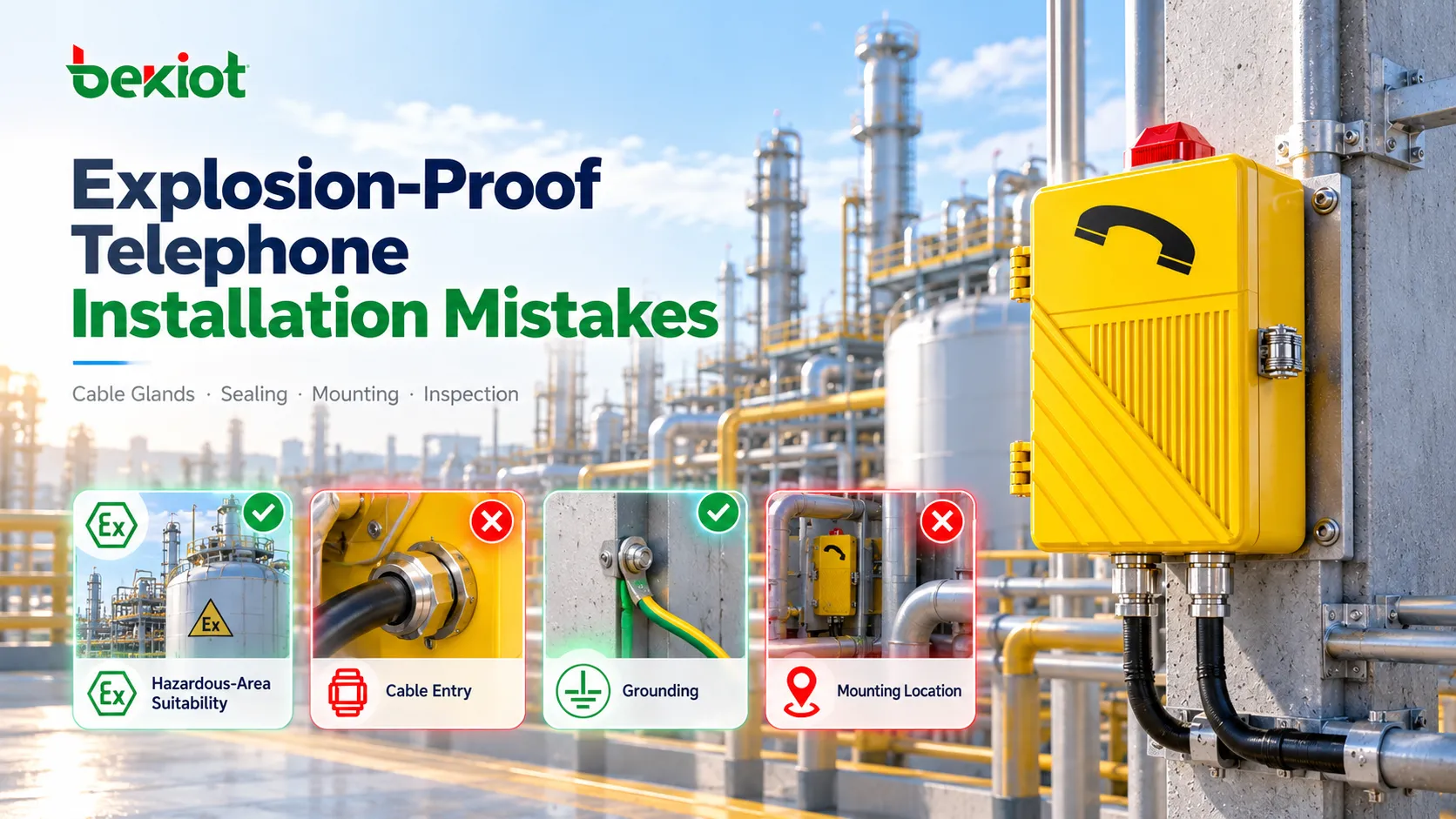


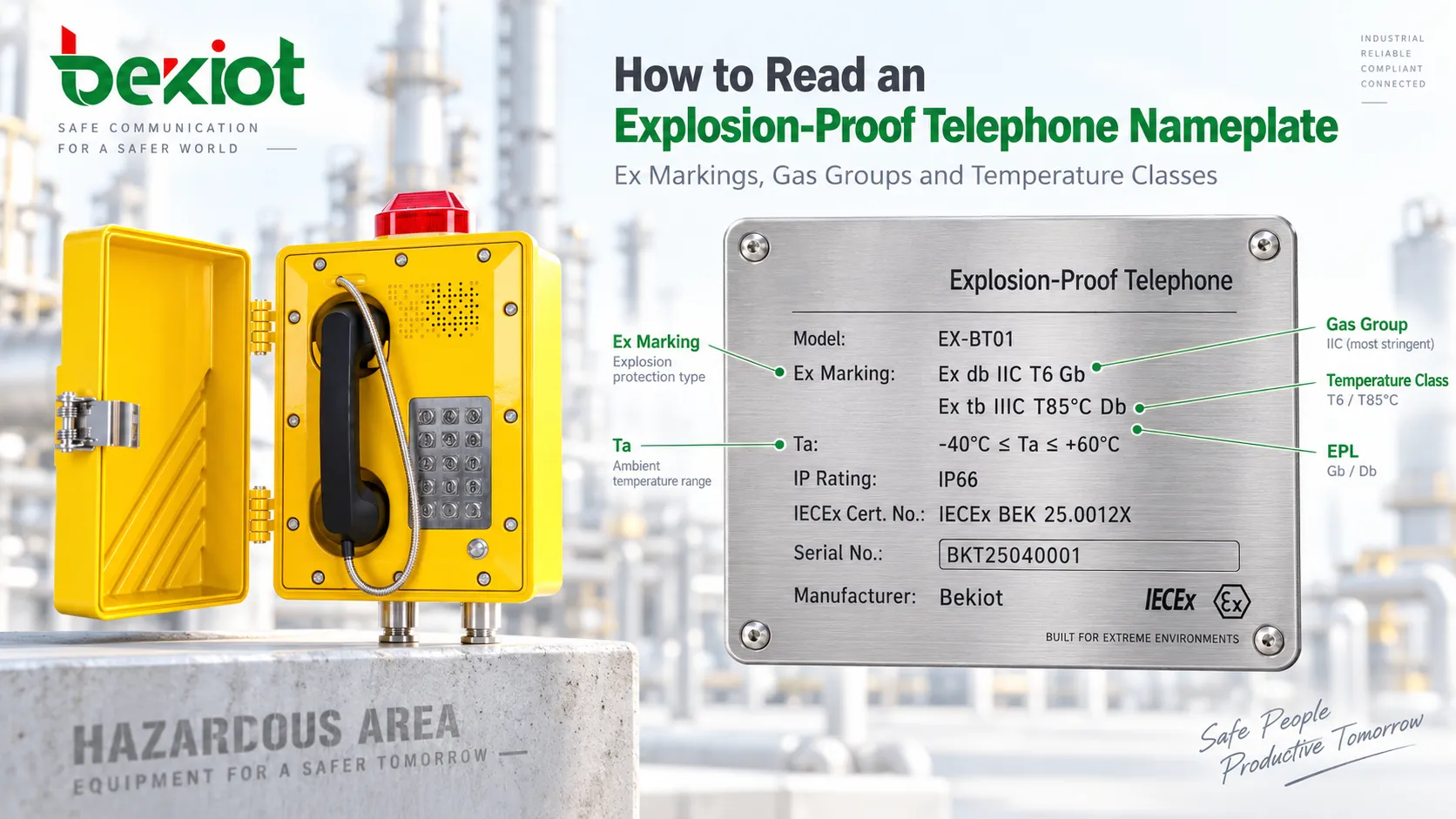
An explosion-proof telephone nameplate identifies the equipment and its marked protection for explosive atmospheres. Read it against the site's hazardous-area classification, then verify the complete model, certificate and installation instructions. A yellow enclosure, an IP rating or the words “IIC T6” alone cannot establish suitability.
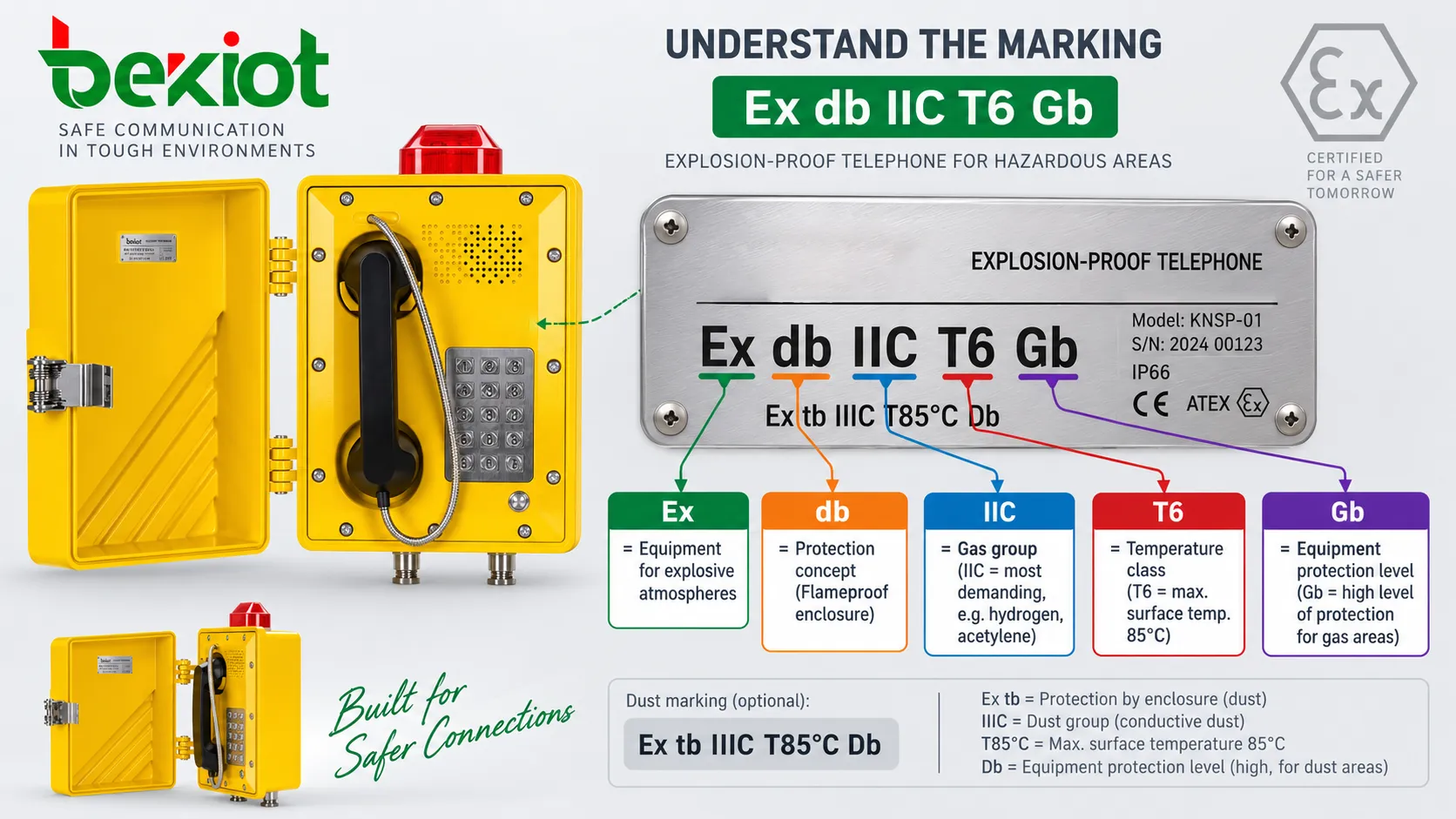
Separate the parts of the Ex marking
The following gas marking is an example, not a claim about a particular telephone:
Ex db IIC T6 Gb| Element | Meaning |
|---|---|
Ex | Marking for explosion protection under the applicable standards. |
db | Flameproof enclosure protection with protection level b. |
IIC | Gas equipment subgroup. |
T6 | Gas temperature class limiting maximum surface temperature to 85°C under specified conditions. |
Gb | Equipment Protection Level (EPL) for gas atmospheres. |
A separately certified dust marking might read Ex tb IIIC T85°C Db: tb is dust protection by enclosure, IIIC covers conductive dust, T85°C states a maximum surface temperature, and Db is the dust EPL. Gas and dust markings are separate assessments. A gas approval does not establish dust suitability, and dust selection must consider cloud and layer ignition conditions.
Understand the protection method and assembly scope
Flameproof protection, d or db, uses an enclosure and flamepaths designed to withstand an internal explosion and prevent ignition of the surrounding specified atmosphere. Increased safety, e or eb, applies construction measures against ignition from sparks or excessive temperature under its defined conditions. Intrinsic safety, i with levels such as ia or ib, limits electrical and thermal energy under specified normal and fault conditions; it does not mean that sparks are physically impossible.
A combined marking such as Ex db eb IIC T6 Gb indicates more than one protection method. It is not a ranking in which more letters make a better telephone. Check how each method applies to the certified assembly, terminals and external circuits.
Do not drill an enclosure, substitute fasteners, alter flamepaths or change cable entries without the permitted procedure. A certificate for a component or empty enclosure does not by itself certify the assembled telephone. The enclosure, internals, accessories and installation must match the approved scope.
Match gas groups independently of temperature
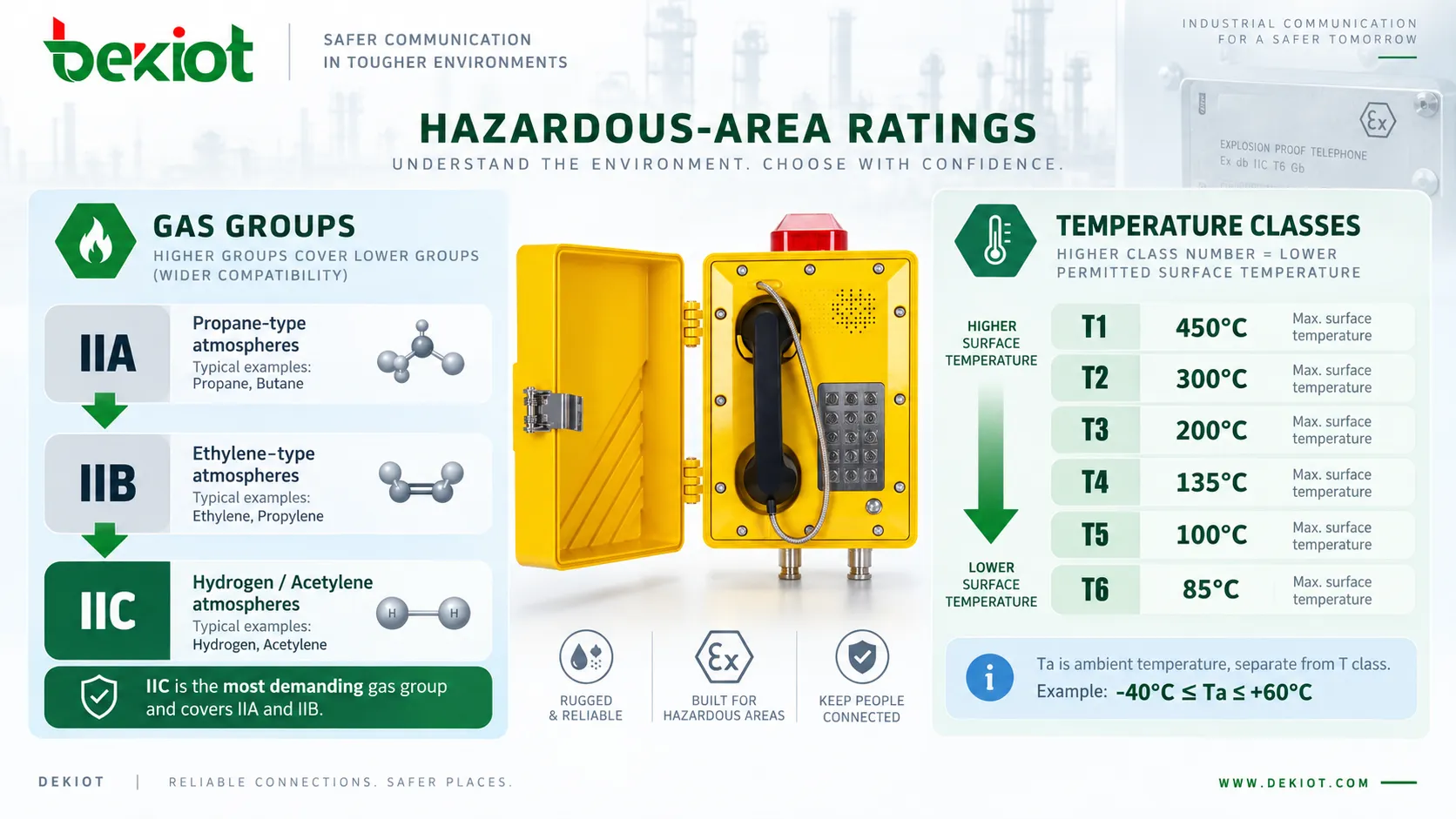
For surface-industry gas atmospheres, Group II is subdivided into IIA, IIB and IIC. Propane, ethylene, and hydrogen or acetylene are familiar representative examples respectively. These are group examples, not complete substance-selection instructions. Mining Group I and dust Group III require their own checks.
| Site gas subgroup | Equipment subgroup that can meet this requirement |
|---|---|
| IIA | IIA, IIB or IIC |
| IIB | IIB or IIC |
| IIC | IIC |
This table addresses only the gas-group requirement, subject to any specific restrictions. IIC equipment can generally satisfy IIB and IIA group requirements, but an IIB marking alone does not meet an IIC requirement. Continue checking temperature, EPL, ambient limits and the complete certificate.
Distinguish T1–T6 from ambient temperature
Gas temperature classes specify maximum equipment surface temperatures under the certified conditions. They are not permissible ambient temperatures.
| Temperature class | Maximum surface temperature |
|---|---|
| T1 | 450°C |
| T2 | 300°C |
| T3 | 200°C |
| T4 | 135°C |
| T5 | 100°C |
| T6 | 85°C |
T6 has a lower permitted surface temperature than T4 and can meet a T4 temperature-class requirement when all applicable conditions are satisfied. It does not mean the telephone may operate in an ambient temperature of 85°C. Check the certified Ta range separately.
For example, -40°C ≤ Ta ≤ +60°C would not cover a site reaching 65°C. Multiple temperature ratings may depend on ambient temperature, electrical load or configuration; use the relevant combination in the certificate rather than selecting the most attractive value from each line.
Check EPL, ingress protection and certificate conditions
Under the usual IEC selection relationship, Zone 0 requires Ga; Zone 1 permits Gb or Ga; and Zone 2 permits Gc, Gb or Ga. For dust, Zone 20 requires Da; Zone 21 permits Db or Da; and Zone 22 permits Dc, Db or Da. Apply the site's assigned EPL and applicable local rules, together with the complete protection method and certificate.
IP66 describes dust and water ingress protection. It is not Ex approval, does not mean unlimited washdown resistance and does not replace a corrosion assessment. Check the required environmental protection without compromising the Ex design.
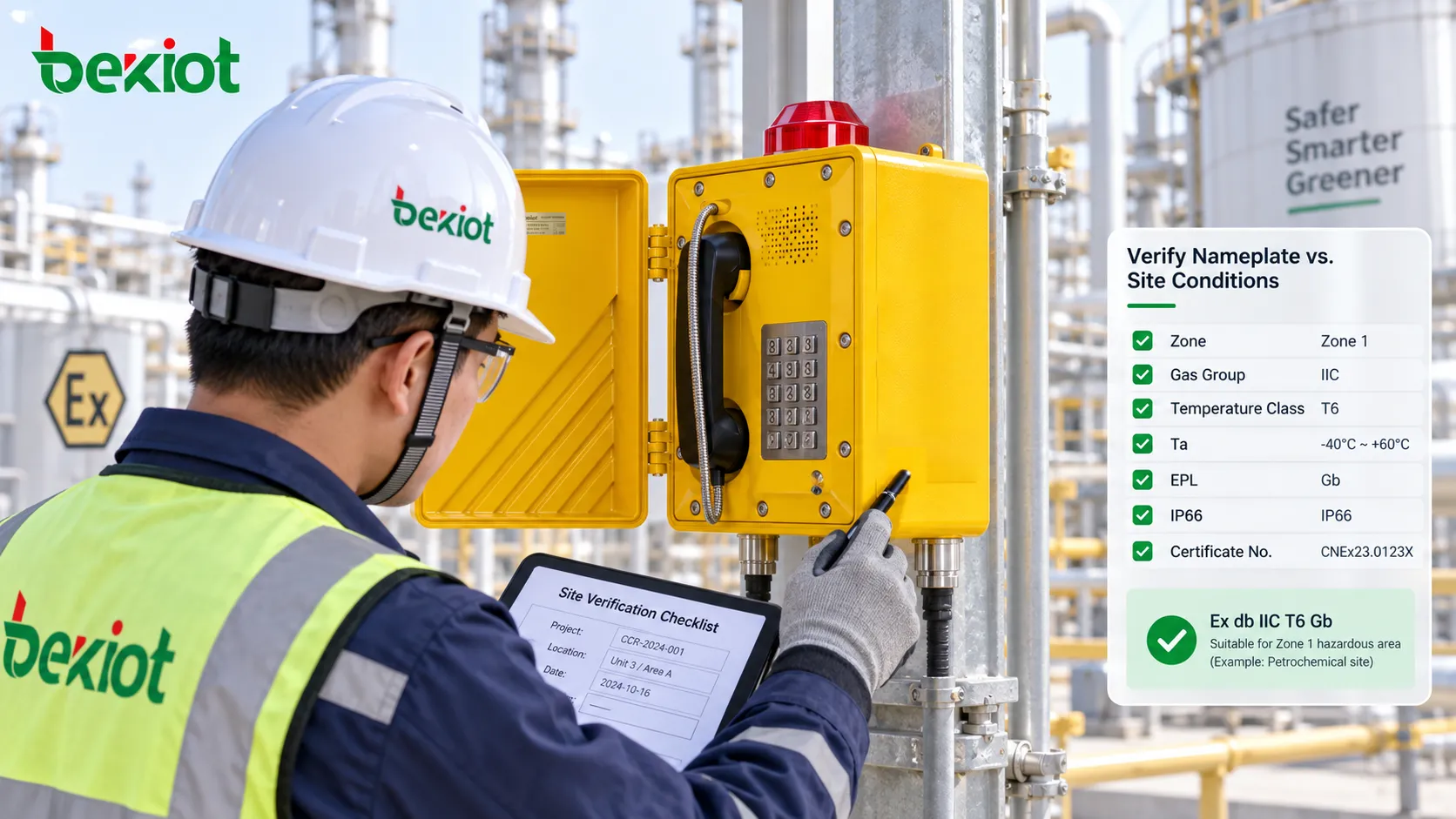
Match the physical model and variant, manufacturer, electrical ratings, ambient range and certificate number to the actual certificate and its current status. An X suffix identifies Specific Conditions of Use that must be followed. A U suffix identifies an Ex component requiring further assessment for incorporation; it is not standalone approval for a complete telephone.
IECEx and ATEX are different conformity frameworks. IECEx certification does not automatically satisfy EU market requirements or every national approval regime. For an ATEX product, check the applicable EU declaration, equipment group and category, gas or dust designation, and conformity documents for the supplied assembly.
Work from the site requirements to the equipment
Suppose the site requires Zone 1, gas subgroup IIB, temperature class T4 and ambient operation from -20°C to +55°C. A marking of Ex db IIC T6 Gb may meet the gas-group, temperature-class and usual EPL requirements, but it says nothing by itself about whether the certified ambient range covers that site.
Confirm gas or dust classification, substance group, required temperature limit and assigned EPL.
Check the complete equipment marking, accepted conformity route and exact certified model or variant.
Verify ambient limits, electrical supply, cable entries, accessories and any X conditions against the proposed installation.
At receipt, compare the physical nameplate with the approved submittal and certificate; resolve missing, damaged or inconsistent identification before installation.
Have competent personnel verify installation and initial inspection records, and retain the documentation for maintenance.
Keep this review separate from choosing SIP, analog or dispatch functions. Those communication features do not establish hazardous-area suitability; the telephone selection guide addresses the broader specification.
FAQs
Does IIC T6 make a telephone suitable for every Zone 1 site?
No. It addresses gas group and temperature class only. EPL, protection method, ambient range, certificate scope, installation conditions and local acceptance must also match.
Can IP66 replace an Ex marking?
No. Ingress protection and explosion protection describe different properties. A weather-resistant telephone may have no hazardous-area approval.
Which marking applies when both IIC and IIIC appear?
Use the gas line for the gas classification and the dust line for the dust classification. IIC and IIIC are not levels on the same scale. Where both hazards are relevant, assess both.
Is an example nameplate enough for procurement approval?
No. Obtain the actual model's marking, full certificate, conditions and instructions, and confirm that they apply to the supplied assembly. An illustration cannot verify product certification.
Official references
IECEx equipment-selection guidance covers groups, temperature classes and installation selection. The IECEx installation symposium explains EPL relationships, X conditions and component scope. The European Commission ATEX overview explains the EU equipment framework.