


A 5G UE can have radio coverage and an active PDU Session when the AMF sends a network-initiated Deregistration Request. The UE has neither powered off nor requested deregistration. The network can terminate registration for operational, reachability or subscription-related reasons.
The useful trace questions are who triggered the decision, which access is affected, whether the UE can receive NAS signaling, whether re-registration is requested and which resources should remain. This guide follows the ordinary 5GS procedure; special services and access-specific branches require the applicable standards conditions.
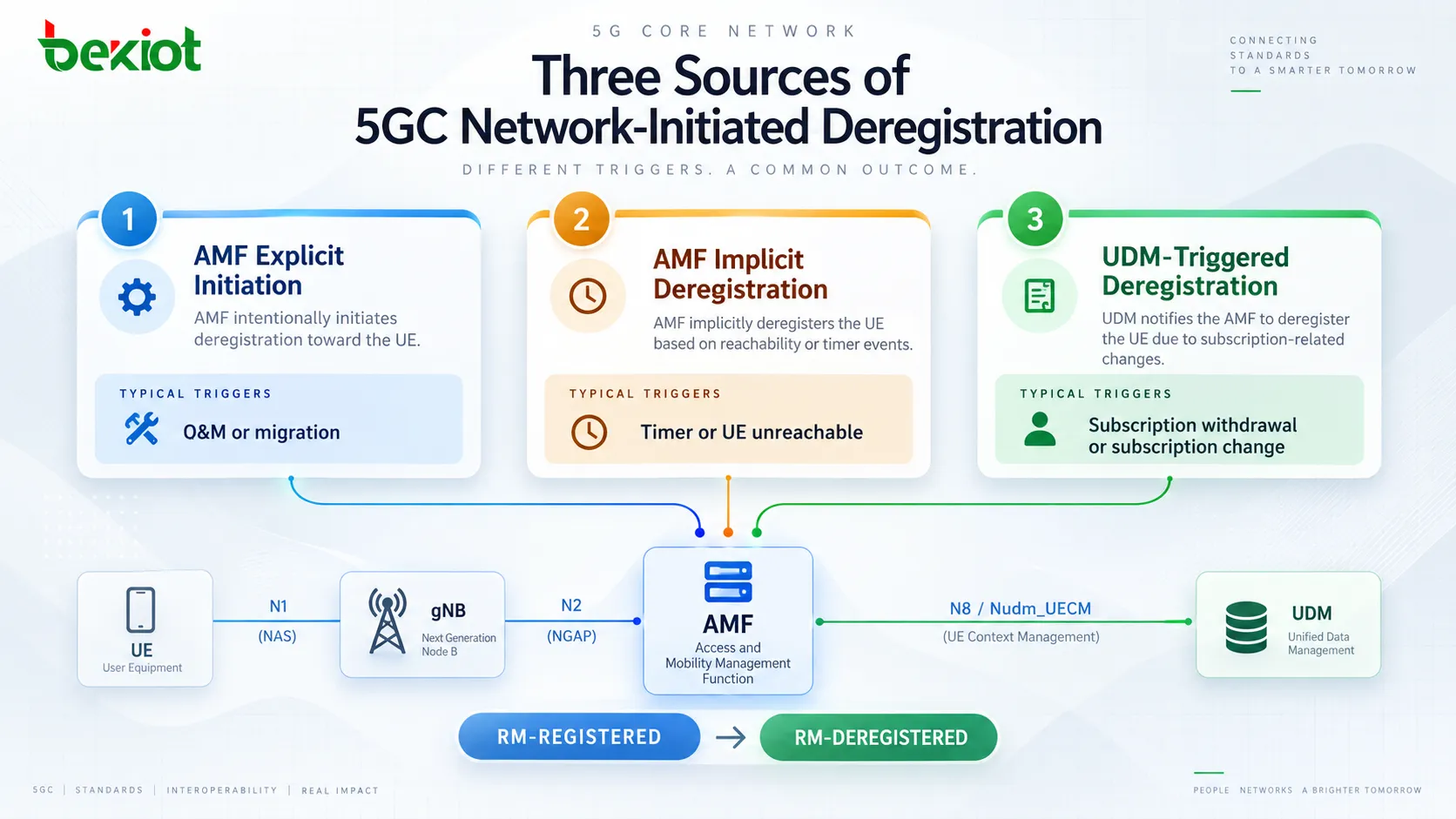
AMF initiation and UDM triggering are different
The AMF executes registration management and UE-facing NAS signaling. An explicit AMF action can follow operations and maintenance intervention or another specified network condition. An operational redistribution may request re-registration, but deregistration is not a mandatory step in every AMF change.
Implicit deregistration is network-side removal of registration context under the applicable conditions, such as expiry of the implicit deregistration timer. A brief radio outage, one missed response or T3512 expiry at the UE is not sufficient evidence that this has occurred.
The UDM can trigger the AMF to remove a subscriber's registration context and affected sessions, for example when the subscription is withdrawn. It does not send NAS directly to the UE. A notification transferring an old serving relationship during mobility must also be distinguished from a subscription-withdrawal request.
Registration state is access-specific. After implicit cleanup, the AMF can regard the affected access as RM-DEREGISTERED while an unreachable UE has not yet learned that state. Do not infer an immediate synchronized UE state change from deletion in the network.
Explicit NAS signaling and implicit cleanup
For explicit deregistration, the AMF sends Deregistration Request toward the UE and identifies the access to be deregistered. A UE in CM-IDLE over 3GPP access may first need paging. The access carrying the message and the access being deregistered are not necessarily the same when the UE is registered through both accesses.
A reachable UE normally returns Deregistration Accept. Missing acceptance requires examination of delivery, timer and abnormal-procedure handling; it does not alone establish implicit deregistration. Network cleanup and UE confirmation are related operations, not proof of an identical timing sequence in every capture.
For implicit deregistration, the AMF does not send a NAS Deregistration Request to the UE. Confirm timer history and AMF context handling instead. A capture that starts late or omits the NAS interface can also lack the request, so absence from a partial trace is not enough to classify the procedure.
How subscription withdrawal reaches the AMF
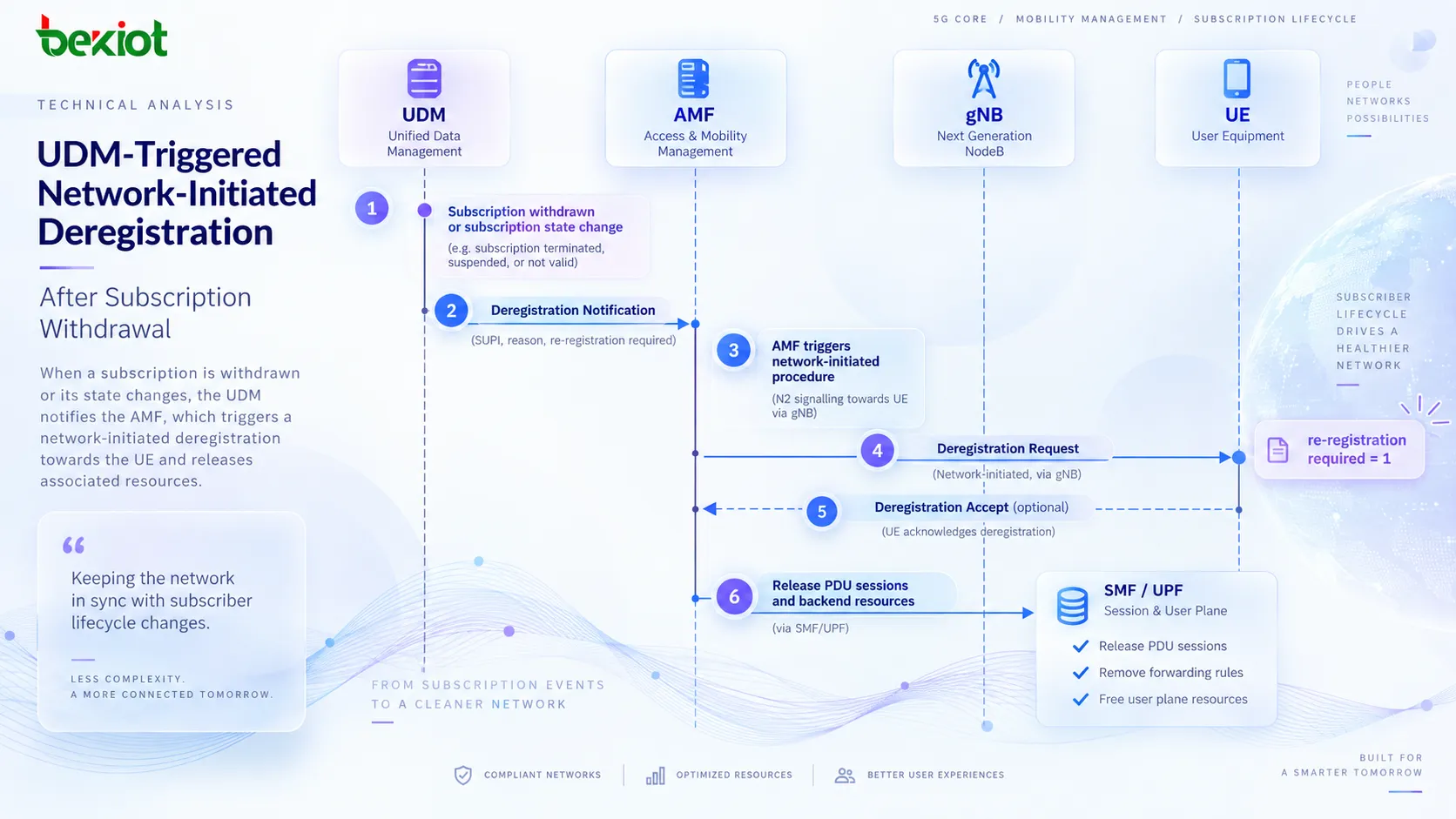
The UDM invokes Nudm_UECM_DeregistrationNotification using the callback registered by the serving AMF. For subscription withdrawal, the removal reason is SUBSCRIPTION_WITHDRAWN. The access indication can cover 3GPP access, non-3GPP access or both; 3GPP_ACCESS is one API value.
The AMF performs deregistration for the indicated access and acknowledges the notification. In an API trace, check the callback destination, reason, access indication and HTTP response. The acknowledgment confirms notification handling; it does not independently prove that every PDU Session and user-plane resource has already been removed.
In the network-to-UE NAS message, the De-registration type IE identifies the affected access and whether re-registration is required. A 5GMM cause can further govern UE behavior. Unlike the UE-originated request, the ordinary network-originated request does not carry a 5GS mobile identity IE; identify the subscriber through the existing signaling context.
The re-registration indication requests another registration procedure; it does not promise acceptance. Subscription entitlement, access restrictions and the received cause still apply. Do not derive a fixed re-registration required = 1 merely from SUBSCRIPTION_WITHDRAWN.
Release only the resources affected by deregistration
For PDU Sessions that must end, the AMF requests SM Context release from the relevant SMFs. The SMF removes the applicable UPF state through N4 session release and handles associated user-plane resources and SM Policy termination. UDM session registrations or data-change subscriptions are removed when their conditions are met.
AM Policy and UE Policy associations can also need termination when the UE is no longer registered over any access. If another access remains valid, blanket deletion of subscriber context and policy state is incorrect. Account for ordinary single-access sessions, multi-access sessions and any retained valid service state.
After the applicable NAS and resource handling, an existing access signaling connection can be released. Releasing a radio or N2 connection alone does not prove deregistration, and deleting one PDU Session does not automatically remove registration.
Emergency service is a material exception. In the reference procedure, an established emergency PDU Session prevents the AMF from initiating deregistration; the AMF instead releases non-emergency PDU Sessions as specified. Do not apply an unconditional “release every session” rule.
Read the origin, direction and resulting state together
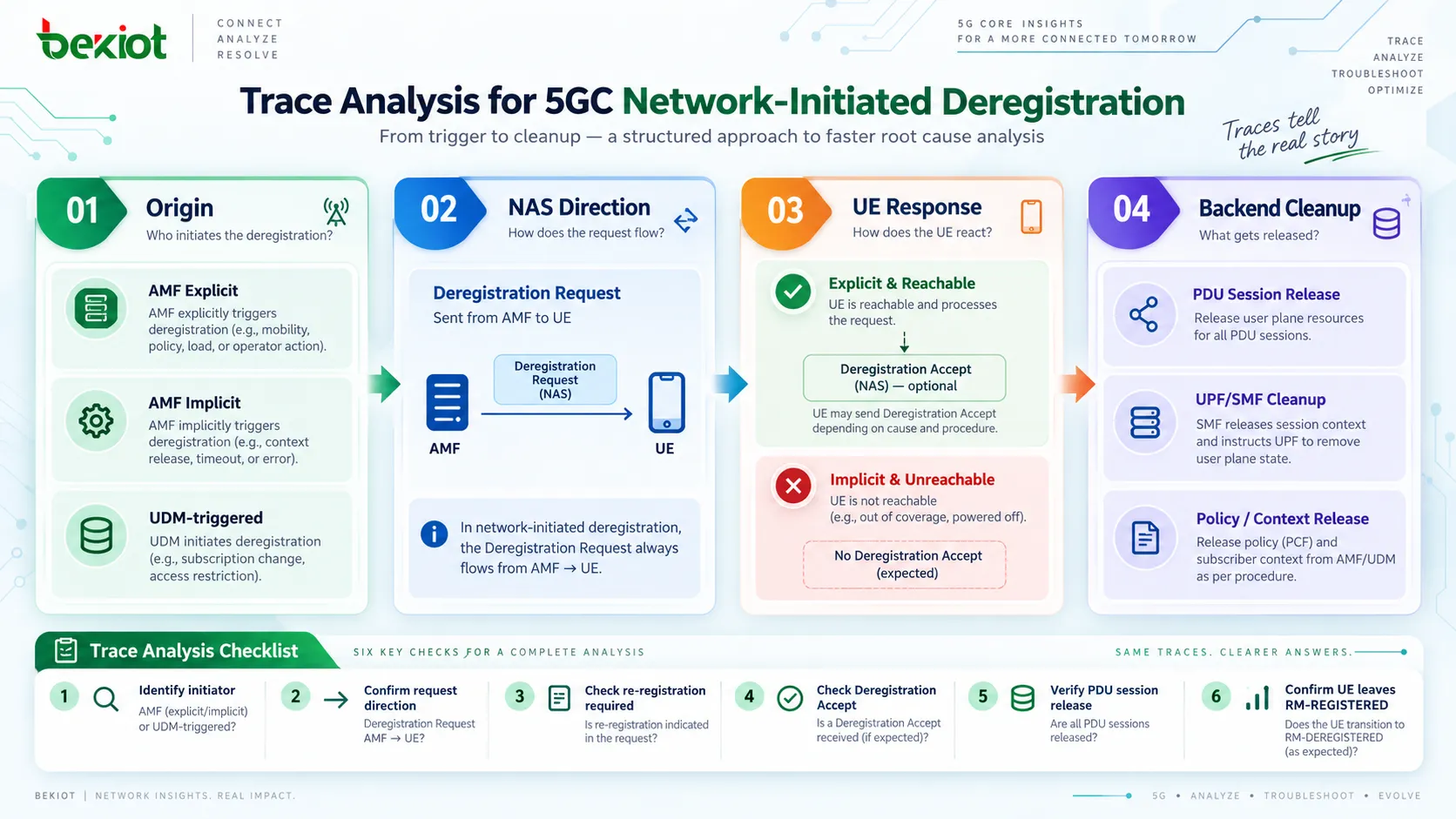
An earlier UDM notification with the relevant removal reason supports a UDM-triggered case. An AMF operational record can support direct explicit initiation. A timer expiry and network context removal without a NAS request can support implicit deregistration. The first visible packet is only the first packet captured, so correlate NF logs before assigning cause.
Establish the trigger using AMF and UDM records, timestamps and the subscriber context. Separate subscription withdrawal from transfer of an old serving relationship.
Confirm the NAS direction. In network-initiated deregistration, the request is AMF → UE and acceptance is UE → AMF; UE-initiated deregistration reverses those roles.
Read the access indication, re-registration requirement and any 5GMM cause. Check paging, NAS delivery and timer handling where the UE is not already connected.
Verify release of affected SMF/UPF resources and obsolete policy or UDM relationships. Confirm that context needed by another access or valid session remains.
Check the AMF's access-specific registration state and the UE's observable response separately. If re-registration is required, follow the subsequent attempt and its actual result.
This approach distinguishes a network decision from failed message delivery and from later cleanup. It also avoids interpreting every missing HTTP exchange as a protocol error when a conditional branch or retained context explains it.
FAQs
Must the UE receive a Deregistration Request?
No. Implicit deregistration omits that NAS message. Explicit deregistration attempts UE notification under the applicable conditions; a missing message in a partial capture does not identify the branch by itself.
Can the UDM send a NAS deregistration request?
No. It notifies the serving AMF through its service interface. The AMF handles the UE-facing NAS procedure and access-specific registration context.
Does re-registration required guarantee restored service?
No. It directs a new registration attempt. The network still evaluates the updated subscription, restrictions and applicable cause; acceptance and data connectivity must be verified separately.
Is cleanup entirely different from UE-initiated deregistration?
No. Session and policy cleanup can overlap. The key differences are the trigger, NAS direction, expected UE behavior and re-registration control, together with any access or service exceptions.
Related procedures and standards
Compare the signaling direction with UE-initiated deregistration. To distinguish removal of a session from removal of registration, see PDU Session Release.
The stage-2 reference is 3GPP TS 23.502, clause 4.2.2.3.3. NAS behavior and message contents are defined in 3GPP TS 24.501, clause 5.5.2.3; UDM notification data is specified in 3GPP TS 29.503.