

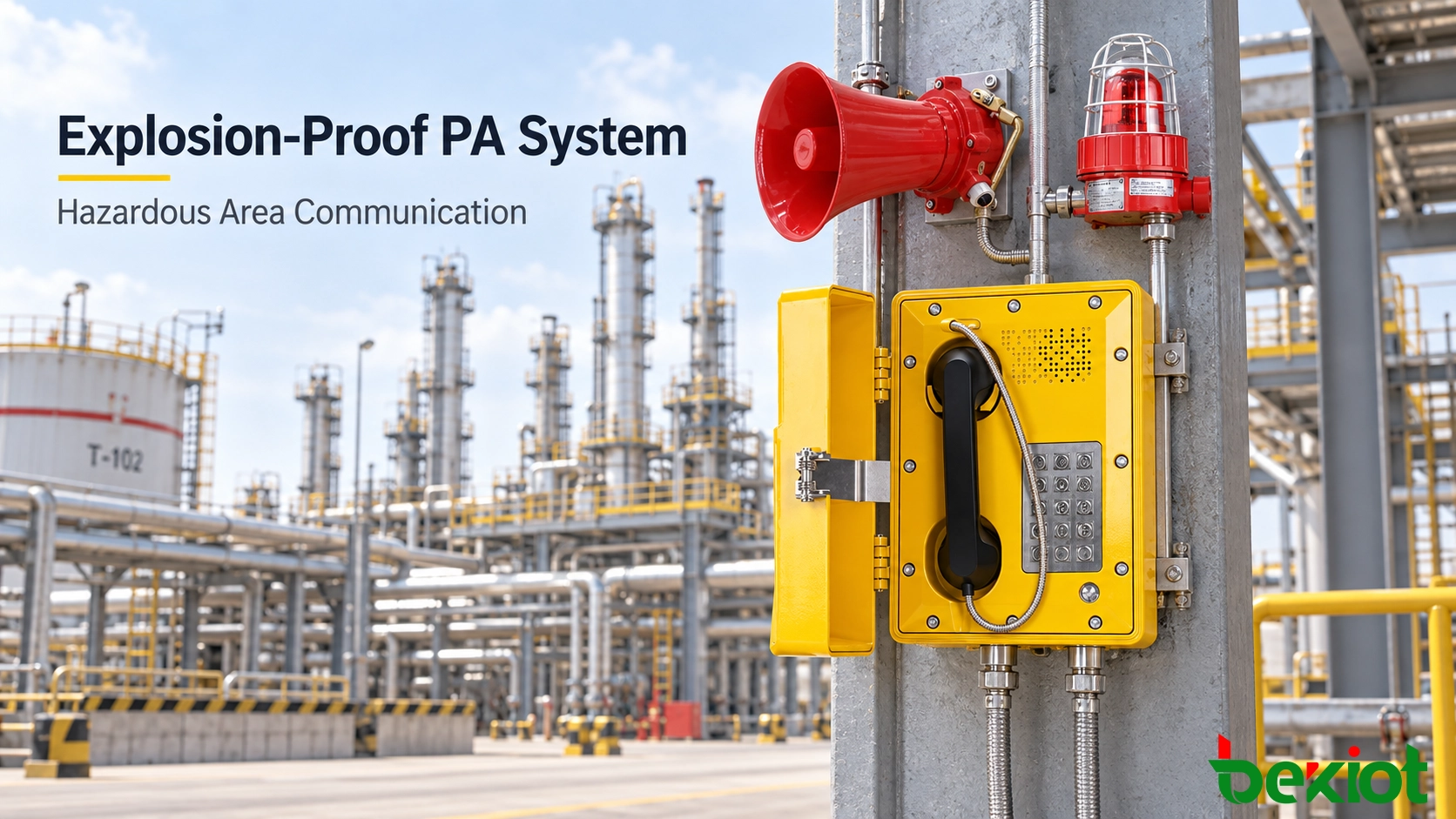
Petrochemical plants, oil and gas facilities, energy sites and hazardous-material storage areas can combine explosive atmospheres with high noise, moisture, corrosion and outdoor exposure. During a gas leak, fire alarm, equipment fault or personnel emergency, operators need to know which areas require a message, whether people can understand it and how field personnel can report back.
An explosion-proof PA system should therefore be treated as an engineered communication system rather than a collection of hazardous-area speakers. Explosion protection addresses ignition risks associated with equipment and its installation; paging, intercom and emergency notification require additional system design. The term “explosion-proof PA” does not itself identify a certificate, protection technique or approved emergency function.
Explosion-Proof PA vs. Standard PA
A conventional PA design addresses audio distribution, paging zones and coverage. Installation in a classified hazardous area adds the need to match equipment and electrical installation to the particular atmosphere and protection requirements. A weatherproof housing, an Ex symbol in a brochure or certification of a different model does not establish suitability.
Begin with the site's approved hazardous-area classification and applicable jurisdiction. Record the zone or Class/Division designation, gas or dust group, required equipment protection level or category, temperature limits and ambient conditions for each location. Gas and combustible-dust suitability are separate checks; approval for one atmosphere should not be assumed to cover the other. The system designer should use the classification supplied by the competent hazardous-area team, rather than infer it from a facility's industry name.
IEC 60079-14:2024 addresses electrical installation design, equipment selection, installation and initial inspection, including documentation and personnel competence. Its published scope is not a universal approval rule: local adoption and project requirements still need confirmation. It excludes, among other applications, electrical installations in mines susceptible to firedamp; those require the relevant mining provisions.
Hazardous and Safe Areas
Not every server, amplifier, dispatch console or network switch has to be installed in a hazardous area. Where the approved layout permits, call control, recording, operator positions and central amplifiers can be located in a non-hazardous equipment room. Field loudspeakers, telephones, intercoms, warning devices and their associated connections are then selected for the locations where they operate.
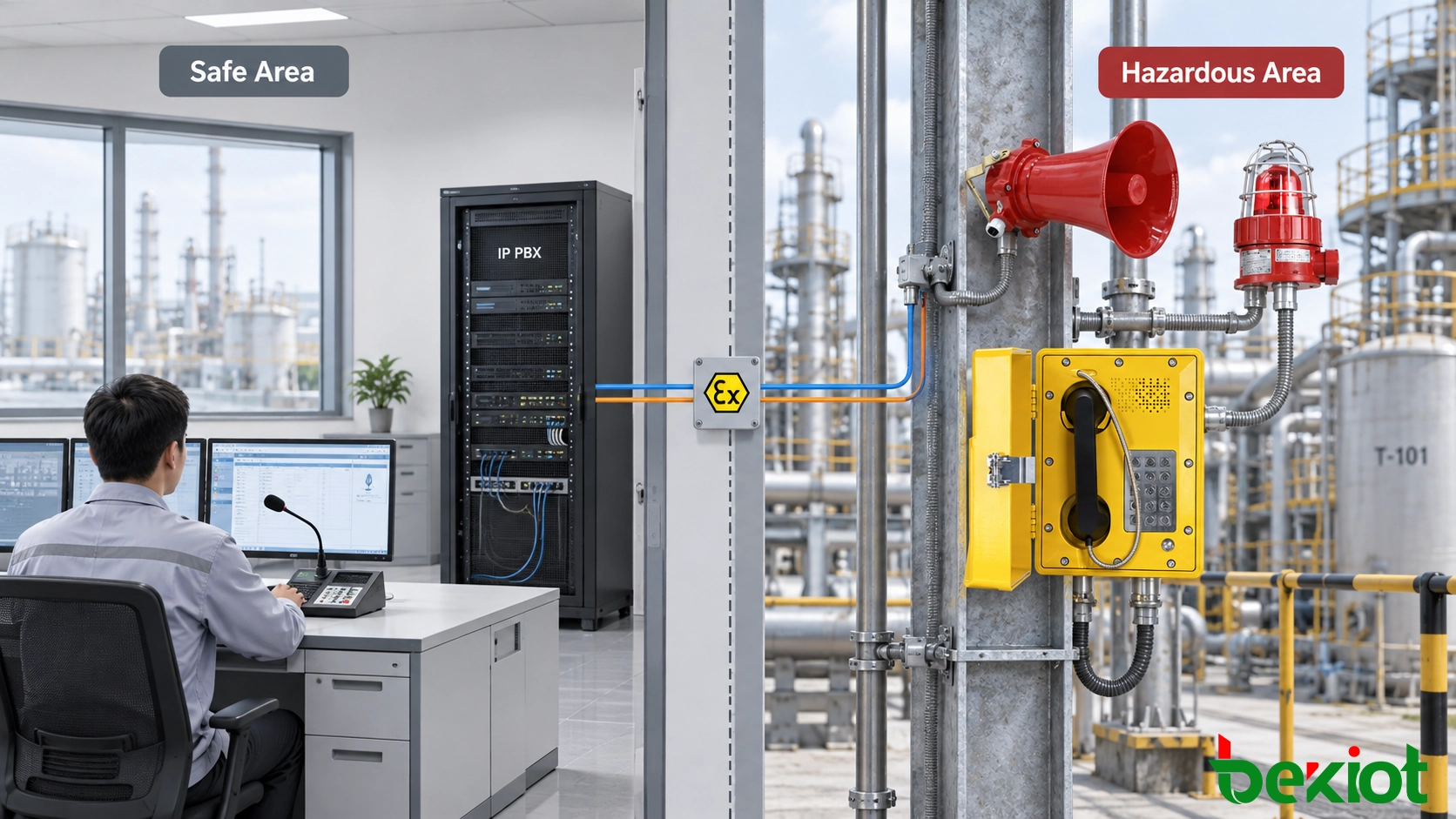
A room is not non-hazardous merely because it contains the control desk. Its status and the routes leaving it belong in the site classification and installation design. Equipment outside the zone can still affect a circuit entering the zone, so the review must follow the electrical connection across that boundary.
Verify the exact equipment and certificate scope
For each proposed item, obtain the exact model and variant, certificate number and issue, certification schedule or annex, installation instructions and relevant drawings. Match these to the supplied nameplate, protection marking, ambient range and electrical ratings. Confirm the certificate's status and any conditions affecting installation or use. Where IECEx certification is claimed, the IECEx equipment scheme identifies its online certificate system as the source for issued certificates. Local acceptance remains a separate project check.
IECEx OD 011-2, Edition 5.9, Sections 1.2.1–1.2.2 and 1.2.20, distinguishes an X suffix for specific conditions of use from a U suffix for an Ex component. A component certificate is not certification of a finished telephone, speaker or assembled system. Read the conditions or schedule of limitations and resolve them before procurement and installation.
Environmental protection also needs separate verification. Ingress protection, corrosion resistance, mechanical exposure and the operating temperature range must suit the location. A product photograph cannot establish these properties, and a device certificate does not approve the complete PA installation.
Speaker Selection, Circuits and Placement
Speaker selection should not begin with wattage alone. The practical objective is intelligible speech where personnel work or move while the plant is operating. Horn speakers can provide directional coverage in outdoor or noisy areas; other formats may suit corridors, platforms or spaces needing more even distribution. The format still has to be available with suitable hazardous-area approval for its intended position.
Review the complete audio circuit with the responsible electrical designer. A passive loudspeaker requires a compatible amplifier output and circuit arrangement; a powered network speaker has its own supply and network-interface requirements. Check the speaker load, permitted amplifier drive, any transformer settings, cable losses, protection arrangements and fault-monitoring method against the selected equipment and project requirements. Installing a certified speaker does not make any amplifier, cable or output configuration acceptable.
Cable glands, entries, stopping plugs, junction boxes, earthing or bonding arrangements and wiring methods form part of the installation review. Their suitability must be established together with the equipment's protection technique, instructions and applicable installation rules. If intrinsic safety is used for any part of the design, the connected circuit needs an appropriate system assessment; low voltage or an individual component certificate is not sufficient. These decisions require competent design and inspection, not adaptation from a promotional diagram.
For acoustic planning, survey:
Background noise during normal and representative high-noise operation.
Personnel positions, access routes and the effects of hearing protection.
Mounting height, speaker orientation, listening distance and obstructions from vessels or pipework.
Reflections, reverberation and overlapping sound from adjacent speakers or zones.
Outdoor exposure and the environmental conditions relevant to the installation.
Increasing amplifier or speaker power does not automatically improve intelligibility. Poor orientation, excessive overlap or strong reverberation can leave speech unclear even when the sound level is high. Agree the acoustic acceptance method and criteria before purchasing equipment, then test representative listening locations and operating conditions. Rated wattage, codec bandwidth and a successful paging connection are not substitutes for those results.
Intercom and Paging
Public address is primarily one-to-many communication. Telephones and intercom stations add a return path for personnel to report conditions, ask for assistance or confirm an instruction. Locate these stations where they can be reached and operated under the site's working conditions, including gloves, noise, signage and access restrictions.
A typical communication sequence is a field call, control-room answer, location and situation confirmation, contact with the response team, area paging and continued field feedback. This is an operational example; it does not replace the site's emergency procedure or require personnel to approach a hazardous location to make a call.
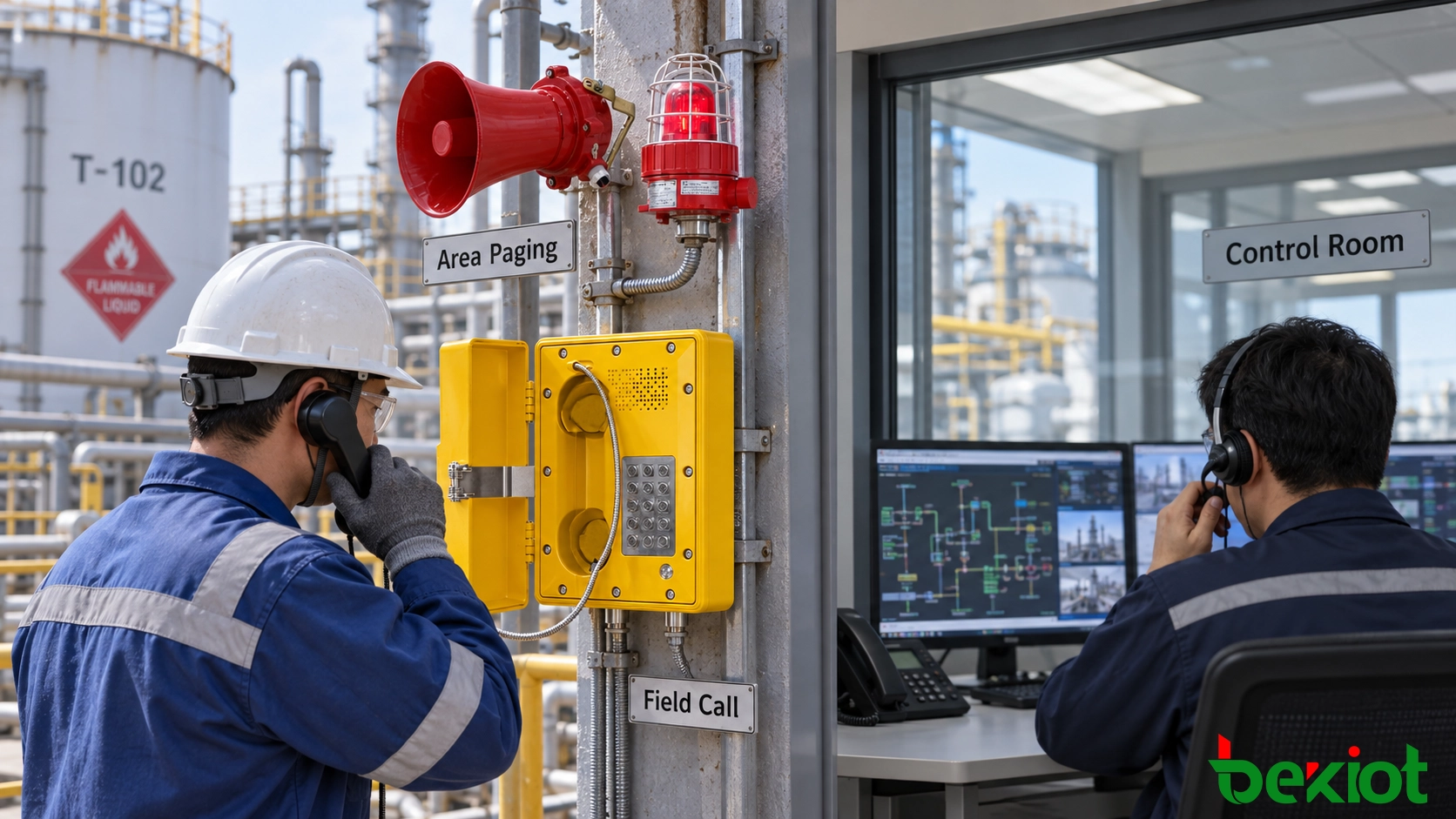
In a SIP/IP design, compatible field terminals can use an IP PBX or communication platform. Group calling, conferencing, recording, forwarding, alternate destinations and supervisory controls depend on the selected platform, endpoints and configuration. SIP support alone does not confer emergency override or a certified alarm function. The paging and intercom broadcasting solution provides an internal reference for these communication roles; project capabilities still need confirmation.
Alarm-Triggered Paging
Fire & Gas, fire detection, process monitoring and communication systems can exchange events where compatible, documented interfaces are provided. A relay contact, digital input or API is an interface mechanism; it does not by itself establish an approved emergency response. The responsible safety and controls teams should define a cause-and-effect schedule stating which event activates which zone, message or warning device.
That schedule should distinguish automatic actions from operator-selected announcements, identify message priority and define acknowledgment, cancellation and reset authority. Do not insert an operator or camera-verification step where the approved alarm design requires immediate automatic action. Conversely, an informational event should not initiate an evacuation message merely because it shares an input interface.
Specify the response to a lost connection, failed amplifier, failed speaker circuit or unavailable controller, including how a fault is reported and which communications remain available. Where audible and visual warnings are required, select both for the classified location and their notification duty. CCTV supplies visual context; it does not verify the absence of gas or replace the alarm system's detection function.
Test alarm linkage against the approved schedule using an authorized commissioning procedure. Confirm the actual output zone, message, priority and reset behavior, including conflicting requests and relevant failures. A software event log alone does not prove that the intended field announcement occurred.
SIP PA vs. PAGA
SIP describes a communication protocol; PAGA means Public Address and General Alarm and describes system duties. These are different dimensions of a design. The need for general alarm, emergency voice functions, fault monitoring, power endurance or redundant paths follows the site's risk assessment and governing requirements, not simply whether the facility is small or large.
A PAGA system specification may include priority between routine paging and alarms, predefined tones or messages, monitored audio circuits, backup power, redundant resources and interfaces with dedicated safety systems. Each requirement needs an identified owner, supported implementation and acceptance evidence. A SIP-based architecture may form part of that solution, but SIP support or an Ex-certified endpoint does not establish system compliance.
Deployment Checklist
The following is a planning checklist for the project team. Applicable legal, certification and adopted-standard requirements take precedence; the checklist is not a declaration of conformity.
| Design item | Evidence or decision to retain |
|---|---|
| Hazardous-area basis | Approved classification drawing, zone extent, substances, gas or dust group, temperature and ambient conditions. |
| Equipment suitability | Exact models and variants, nameplates, applicable certificates and issues, conditions, instructions and local acceptance. |
| Audio and electrical circuits | Compatible speakers and amplifiers, loads, supplies, cable and entry arrangements, protection and any required system assessment. |
| Acoustic coverage | Noise survey, listening locations, speaker layout and agreed intelligibility acceptance results under recorded conditions. |
| Field communication | Station locations, response destinations, usable controls, call-location labels and alternate response arrangements. |
| Alarm and paging control | Cause-and-effect schedule, zones, message priorities, authorization, conflict handling and reset behavior. |
| Power and resilience | Required operating duration, supported loads, failure dependencies and verified behavior on loss of power, controller or network. |
| Installation and handover | Competent initial inspection, as-built records, functional tests, configuration backups and inspection and maintenance responsibilities. |
Retrofits also need an inventory of existing telephone, paging and alarm circuits. Serviceable equipment may be retained only after suitability and interface compatibility are checked; adding a gateway does not preserve approval automatically. Record which existing functions will remain available during the work and how changes affect the emergency arrangements.
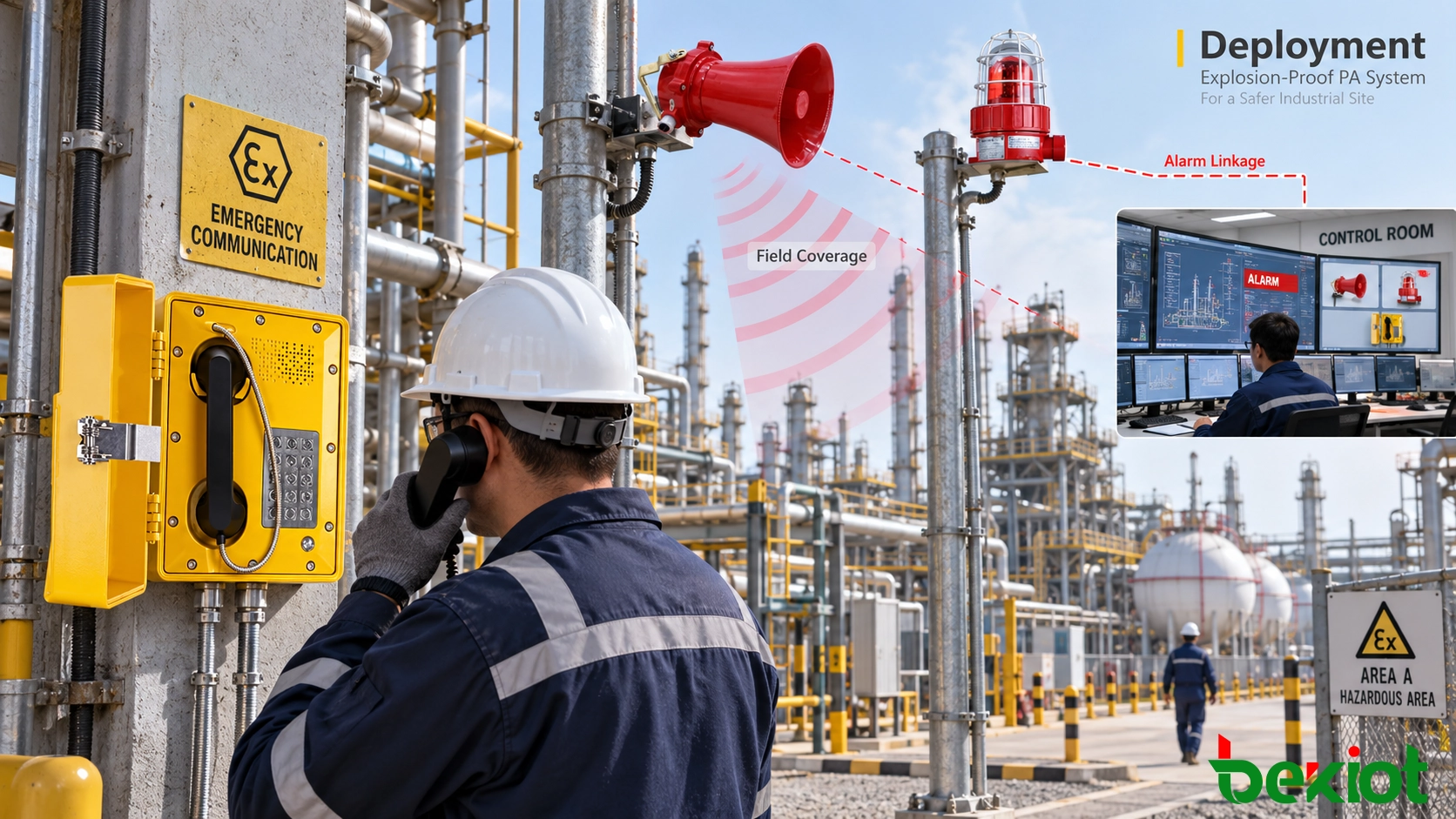
Complete the hazardous-area and electrical review, acoustic design, interface definition and acceptance plan before finalizing equipment quantities. Handover should demonstrate both suitability for the installation and the required communication behavior. Keep inspection and maintenance arrangements alongside the drawings so later equipment or configuration changes can be reviewed against the same design basis.
FAQs
Can a certified enclosure make an ordinary PA amplifier suitable for a hazardous area?
Not automatically. The enclosure certificate may cover only a component, while the installed amplifier changes heat generation, connections and other conditions. The proposed assembly and installation need the relevant assessment before they can be accepted.
Does approval for explosive gas also cover combustible dust?
Do not assume so. Check the exact gas and dust protection markings and certificate scope against the site's classification and temperature requirements. Dust accumulation and environmental conditions also belong in the installation and maintenance review.
Can a new speaker be substituted if its wattage is the same?
Equal wattage is not enough. Recheck the replacement's approval, electrical compatibility, acoustic characteristics, mounting and installation conditions. Update the records and repeat the acceptance checks affected by the change.
Does a successful field call confirm that emergency paging works?
No. The call can use different media, amplifier, power and control paths. Paging needs its own zone, priority, acoustic and failure checks, including the approved interface to any alarm system.