

Selecting a cleanroom telephone requires more consideration than choosing a standard office communication device. In pharmaceutical manufacturing, semiconductor production, laboratories, and other controlled environments, communication terminals must provide reliable voice communication while matching cleaning procedures, installation requirements, and long-term maintenance plans.
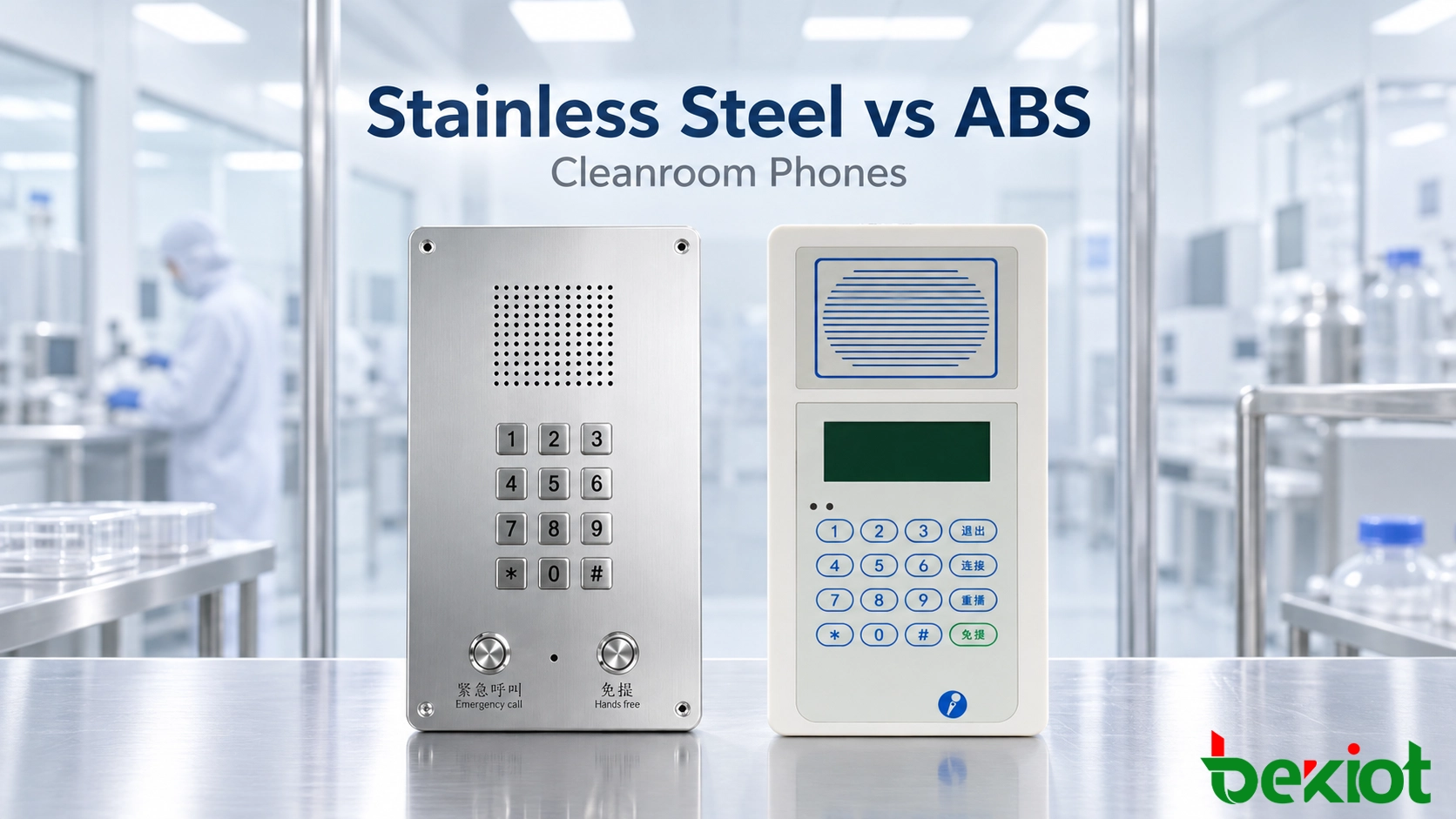
Stainless steel and ABS are two enclosure options, but neither is the better choice for every facility. A stainless-steel panel may be preferred for a robust fixed installation; an ABS model may suit a project that prioritizes handling weight and a different control layout. These are reasons to compare particular products, not proof of impact resistance, chemical compatibility or cleanroom suitability. SIP and hands-free functions depend on the telephone electronics and design, not its enclosure material.
The best choice is not always the strongest material. Engineers should evaluate the complete application environment, including cleaning frequency, installation location, operating conditions, maintenance strategy, and expected service life before selecting a cleanroom telephone.
Why Cleanroom Telephone Material Matters
Cleanroom phones may encounter repeated cleaning, gloved operation and tightly controlled maintenance access. Material selection affects the exposed surfaces and how their condition can be maintained. The complete design also matters: a smooth panel with difficult-to-clean buttons, speaker openings or wall joints still needs careful assessment.
Resistance to the actual cleaning and disinfecting process;
Surface condition after repeated use and wiping;
Mechanical protection of the finished device;
Mounting loads, sealing and access for replacement;
Evidence supporting the intended controlled environment.
Enclosure material is only one part of cleanroom telephone selection. The mounting method, communication protocol, user interface and system compatibility should also match the project requirements.
Communication Requirements in Different Cleanroom Areas
Cleanroom environments are not identical. Different areas within the same facility may have different communication requirements depending on workflow, personnel activities, and equipment operation. A suitable cleanroom telephone should match the specific location where it will be installed.
Production and Manufacturing Areas
In pharmaceutical manufacturing, semiconductor facilities, and precision production environments, communication terminals are often used for coordination between operators, supervisors, and control rooms. Assess frequency of use, nearby handling activities, cleaning exposure and access for repair. A stronger enclosure may be useful where physical damage is a credible risk, but a production-room label alone does not establish that stainless steel is necessary.
Laboratories and Research Areas
Laboratories may place more emphasis on installation flexibility and convenient access. Communication points may need to be added in different rooms according to research activities and facility layout changes. However, a laboratory can also have demanding chemical or contamination-control requirements; it should not automatically be treated as a less demanding application for ABS.
Supporting Areas and Clean Corridors
Technical rooms, preparation areas, and clean corridors may require communication mainly for daily coordination and operational assistance. Confirm the room's actual controls and cleaning procedure before relaxing the specification. The same material need not be used throughout a site if each selected device meets the requirements of its location.
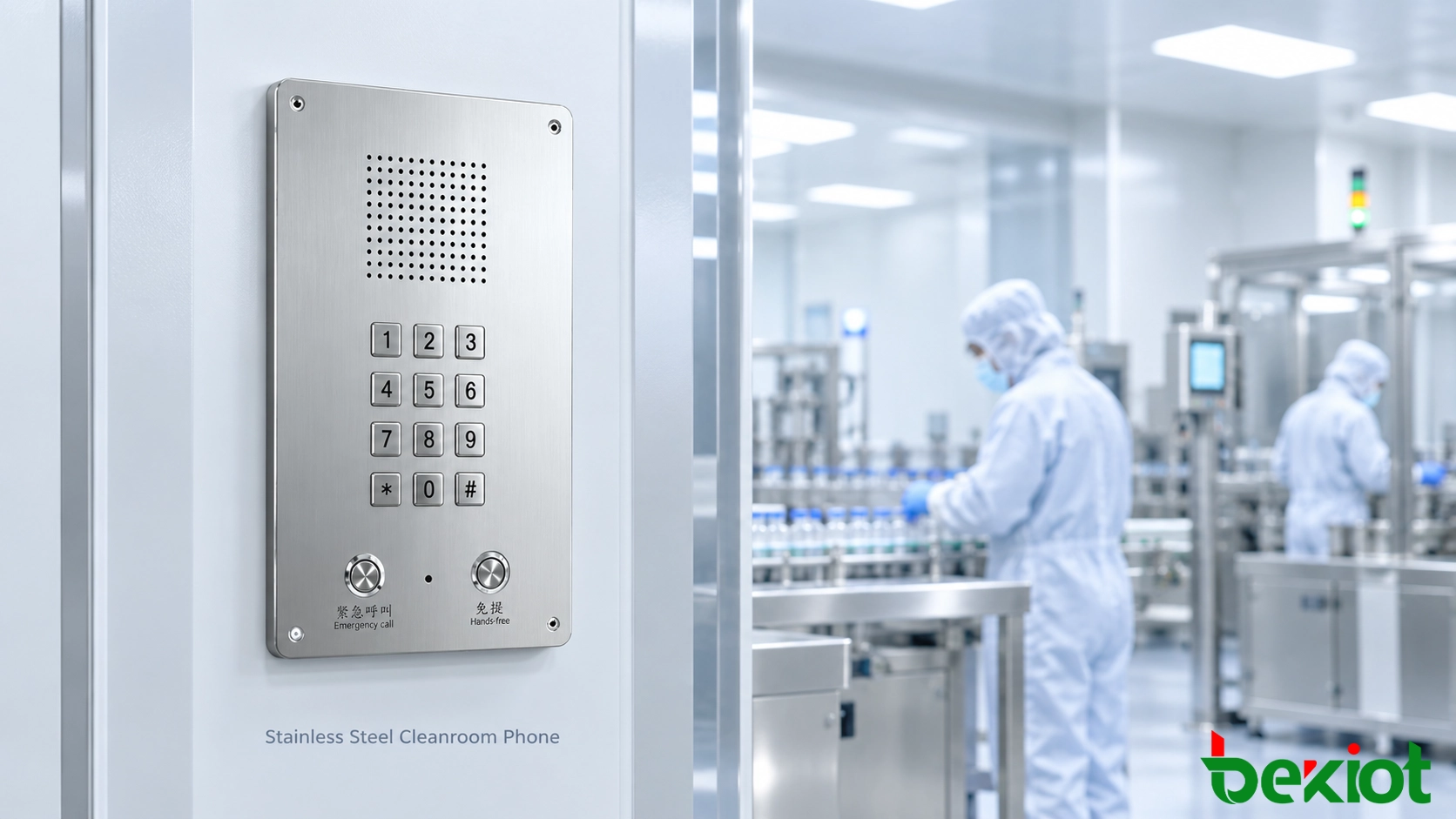
Stainless Steel Cleanroom Phones: What to Verify
Mechanical Protection
A stainless-steel front panel can be a useful construction choice for a fixed communication point. Compare the finished assembly rather than assuming that any metal phone is more durable than any plastic phone. Panel thickness, support, fasteners, keypad construction and an applicable impact-test result are more useful than an unqualified claim of strength.
Cleaning and Surface Maintenance
A metal surface may tolerate the proposed wiping regime, but that must be checked against the specified alloy, finish and cleaning instructions. Evaluate the complete exposed interface, including labels, seals, button surrounds and acoustic openings. Evidence for a flat material sample does not automatically cover every component of an assembled telephone.
Corrosion Resistance and Long-Term Condition
“Stainless steel” is not a guarantee against all cleaning-related damage. Ask for the alloy identification and compatibility evidence for the agents, concentrations, contact times, temperatures and repeated cycles used at the site. Include residue removal and inspection in the approved procedure; do not substitute a general material chart for the manufacturer's instructions and the site's assessment.
Becke's BT26 Cleanroom IP Phone product listing specifies SUS304 stainless steel and flush mounting. Those specifications identify the offered construction; they do not establish a cleanroom class or compatibility with every disinfectant.
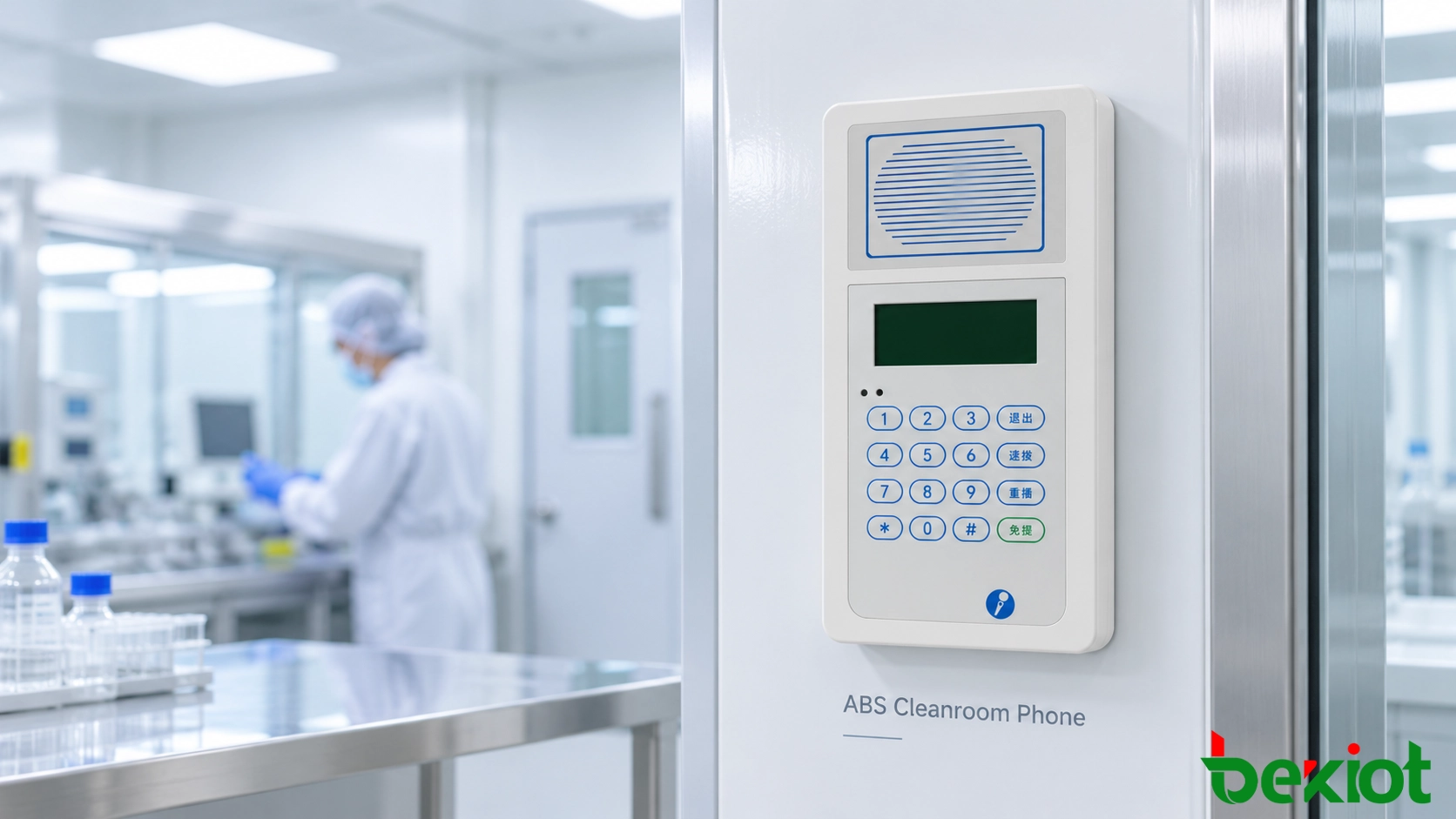
ABS Cleanroom Phones: What to Verify
Handling and Installation Flexibility
An ABS housing can be a reason to investigate a lighter assembly, particularly where many communication points are required. Compare the actual installed weights, dimensions and mounting details of the shortlisted models. Wall preparation, cable access and sealing may affect installation effort more than housing weight.
Suitability for the Intended Controlled Area
ABS is a material family, not a cleanroom qualification. Confirm the exposed polymer formulation or supplier specification where relevant, the surface finish and compatibility of the complete assembly with the intended cleaning cycle. Review any required particle or chemical-emission evidence separately. A phone should not be accepted merely because it is described as suitable for “general controlled environments.”
Multiple Communication Points
Large facilities may require many communication terminals across different areas. In these projects, installation efficiency and deployment flexibility can influence the overall system design. Standardizing an approved model, spare parts and cleaning procedure can simplify maintenance, but the benefit must be assessed against the requirements of each room.
The BT26-ABS Clean Room SIP Phone listing identifies an ABS model with one-touch calling. Compare its controls, power requirements and mounting arrangement as well as its material; do not assume it is simply a material variant with every feature of the stainless-steel BT26.
Stainless Steel vs ABS Cleanroom Phones Comparison
The table separates material considerations from evidence needed to select a finished telephone. It does not assign either material to an ISO class or pharmaceutical grade.
| Category | Stainless-Steel Phone | ABS Phone | Selection Evidence |
|---|---|---|---|
| Mechanical protection | Assess alloy, panel thickness and assembly support. | Assess housing formulation, construction and assembly support. | Relevant finished-device test results and installation requirements. |
| Surface maintenance | Check alloy, finish and all non-metal exposed parts. | Check polymer surface, labels, seals and controls. | Compatibility with the exact cleaning process, including repeated exposure. |
| Installation | A flush or surface-mounted design depends on the model. | A flush or surface-mounted design depends on the model. | Installed weight, wall opening, sealing, cable route and service access. |
| Operating environment | No automatic approval from a metal panel. | No automatic exclusion or approval from ABS construction. | Documented suitability for the location and contamination risks. |
| Lifecycle cost | Use the actual quotation and maintenance assumptions. | Use the actual quotation and maintenance assumptions. | Purchase, installation, qualification, cleaning, spares and replacement costs. |
Does Material Determine Cleanroom Compatibility?
A stainless-steel housing does not automatically mean that a telephone is suitable for every cleanroom classification. Likewise, an ABS housing does not automatically exclude a device from controlled environments.
ISO 14644-14:2026, second edition, addresses equipment suitability with respect to airborne particle cleanliness. Its published scope excludes cleanability, biocontamination assessment, decontamination-agent testing and material selection. A particle-suitability assessment therefore cannot establish all of those other properties.
For sterile medicinal-product manufacture within its scope, EU GMP Annex 1, 2022 revision, sections 4.5–4.7, addresses exposed surfaces, cleanable geometry and materials that permit repeated application of the agents used. Section 4.34 addresses validation of disinfection on the relevant surface material. This is facility and process guidance, not a certificate granted to a telephone because of its enclosure.
How to Select and Maintain the Complete Assembly
Start with the site specification and document the proposed use. The following are practical procurement and engineering checks; the precise evidence and acceptance criteria should be set by the facility team.
Define exposure: record the cleaning products, dilution, wet contact time, frequency, temperature and method of application. Identify any vapour decontamination or other special process separately.
Inspect the interface: check the keypad, microphone and speaker openings, perimeter seal, fasteners and accessible joints. Confirm operation with the gloves actually used.
Review installation: flush mounting can reduce protrusion, but the wall penetration and perimeter still need an approved sealing and maintenance arrangement. Surface mounting may simplify a retrofit while adding surfaces to clean.
Review evidence: identify the tested model, material and revision, exposure conditions and acceptance criteria. Where a new test is needed, agree it with the supplier and the facility's responsible technical team.
Plan service: include spare equipment, replacement access and any cleaning or room-release work needed after maintenance.
The lowest initial purchase cost is not always the lowest total cost throughout the equipment lifecycle. Compare actual quotations and realistic maintenance assumptions; no price premium or longer service life follows automatically from stainless steel, and ABS does not by itself establish a lower installed cost.
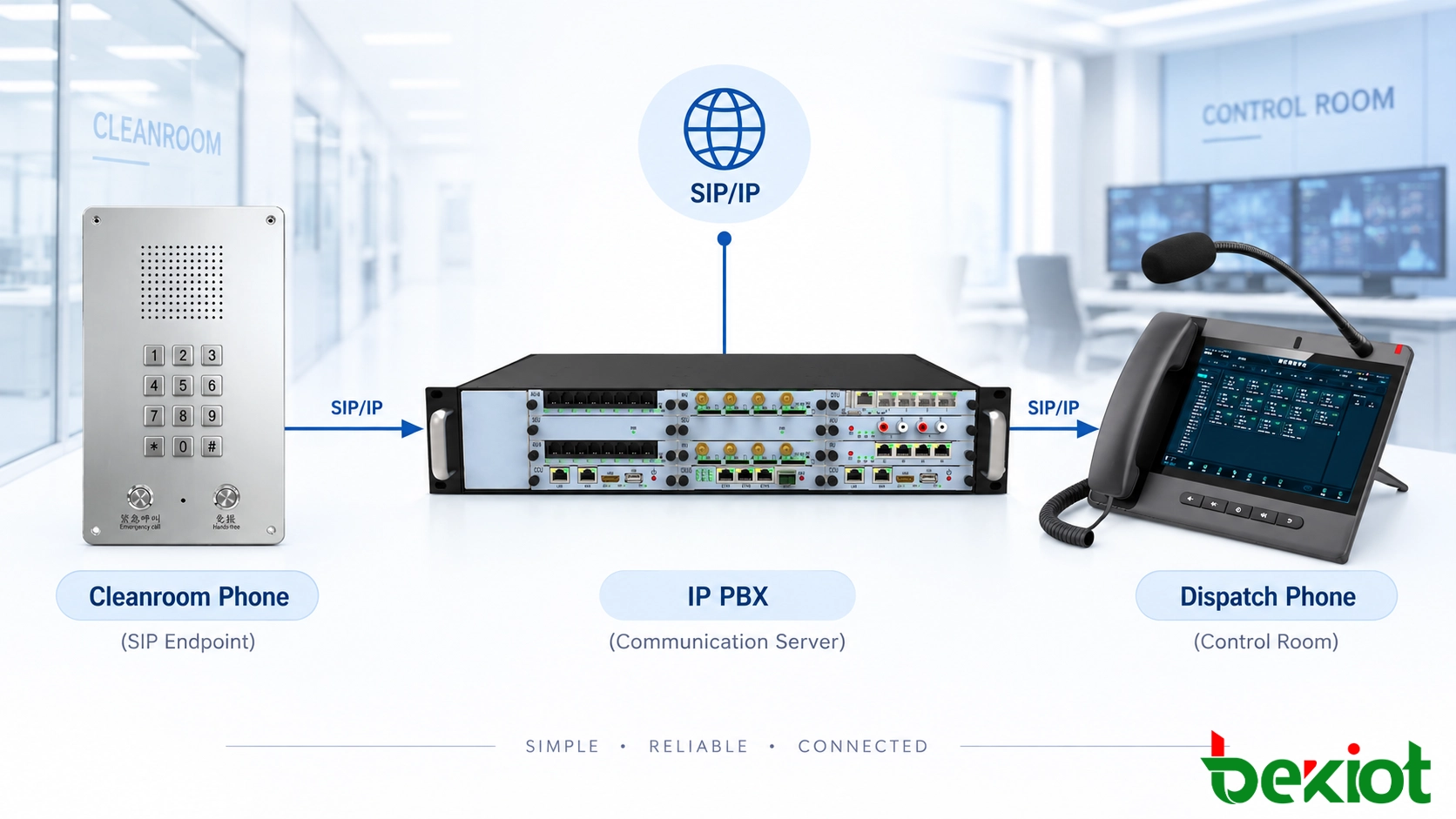
Keep SIP Compatibility Separate from Material Selection
Either construction can be offered with SIP electronics. Confirm the exact model's power supply, network interface, supported account and security settings, controls and interoperability with the intended platform. Transfer, recording or dispatch workflows may depend on that platform and its configuration. The separate cleanroom telephone SIP connection article addresses registration, routing and two-way audio checks.
FAQs
Does a SUS304 specification prove that a telephone is suitable for a sterile area?
No. It identifies a material specification. Acceptance also depends on the complete assembly, installation, contamination risks, cleaning process and the facility's qualification requirements.
Can I substitute a new disinfectant if the old one was acceptable?
Do not assume equivalence. A change in formulation, concentration, contact time or application method may change compatibility and cleaning performance. Review it through the site's change process and obtain evidence for the proposed conditions.
Does a water-ingress rating establish disinfectant compatibility?
No. Water-ingress performance and compatibility with a chemical cleaning process are different properties. Ask what was tested, on which assembly and under which conditions.
Can the complete telephone be autoclaved or exposed to vapour decontamination?
Neither enclosure material establishes that capability. The electronics, seals, controls and installation must also be suitable. Require explicit manufacturer instructions and process-specific evidence before selecting either method.
Is it reasonable to use both materials at one facility?
Yes, if each selected model meets its location's requirements. Keep the approved cleaning instructions, spare parts and maintenance records clear for each model so that staff do not apply one device's procedure to another.