
ข่าวล่าสุด
2026-11-02 15:34:08

การอัปเกรด PA ของ Chesterfield FC: เสียงในวันแข่งขันและการสื่อสารฉุกเฉิน

รายงานการอัปเกรดระบบ PA ของ Chesterfield FC เน้นย้ำความสัมพันธ์ระหว่างเสียงในวันแข่งขันและการสื่อสารด้านความปลอดภัย พร้อมการตรวจสอบภาคปฏิบัติสำหรับความครอบคลุม การเลือกโซน ลำดับความสำคัญฉุกเฉิน และพลังงานสำรอง

Becke Telcom

การอัปเกรด PA ของ Chesterfield FC: เสียงในวันแข่งขันและการสื่อสารฉุกเฉิน

A stadium announcement can be audible without being understandable. Supporters may hear the system working yet miss a player’s name, a change to an exit route or an instruction from the safety team. Replacing a PA system therefore involves more than increasing loudspeaker output.

Chesterfield FC has publicly reported an improvement to its stadium PA. In its announcement ahead of a July 13 home fixture against Nottingham Forest, the club identified a new PA system among changes improving the matchday experience. That statement supports the fact of an upgrade, but does not establish the installed system’s voice-alarm certification, detailed equipment schedule or emergency operating performance.

The useful engineering question is how an installed stadium system serves both everyday announcements and safety communication. The considerations below apply to planning and assessing that relationship; they are not a verified description of Chesterfield FC’s as-built installation.
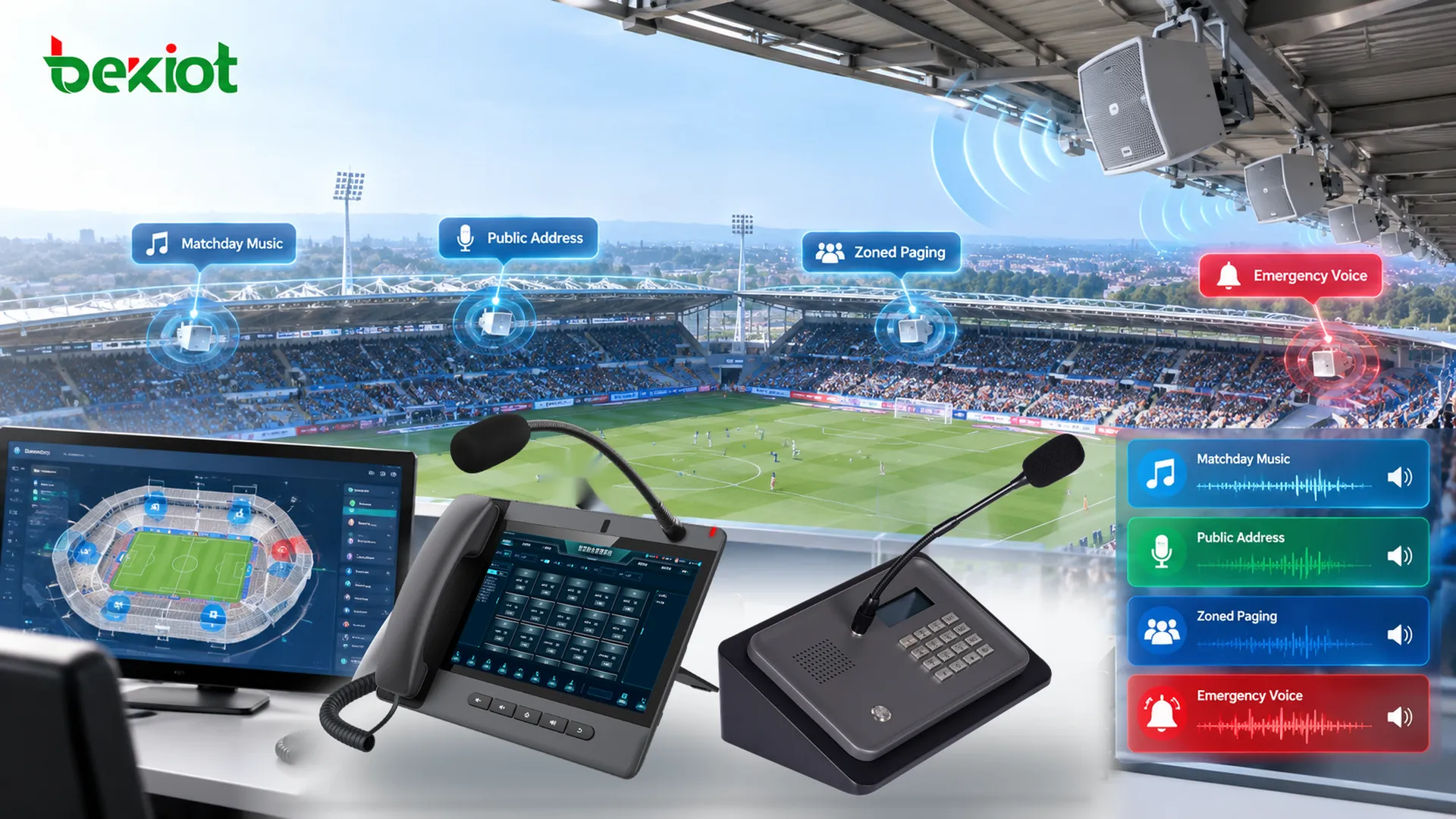
Concept illustration combining stadium music, public announcements, zoned paging and emergency voice communication
Concept illustration of stadium communication functions. This is not a photograph of the Chesterfield FC installation, and the illustrated Becke Telcom equipment does not establish involvement in the club’s project.

What the Club’s PA Update Establishes

The club’s announcement connects the PA upgrade with the supporter experience. It does not publish acoustic measurements, a zone schedule, a commissioning certificate or a verified completion date for a separate October 2026 project. Those details should not be inferred from the date on a later trade-media report.

This distinction matters when reviewing stadium upgrade news. A positive description of matchday sound is useful operational feedback, but it is not a measured intelligibility result. Likewise, a system described as suitable for emergency announcements should not automatically be presented as a certified voice-alarm installation.

For a project team, the missing evidence would normally come from the approved design, equipment documentation, installation records and acceptance results. Without those records, a report can discuss the engineering questions raised by the upgrade while keeping the actual project claims narrow.

Matchday Audio and Safety Messages Need Different Priorities

Music, presenter microphones, routine paging and emergency messages can share parts of a stadium audio installation, but their operating priorities must be defined. A music source playing correctly does not demonstrate that an emergency microphone can reach the necessary areas or take control when required.

The UK Sports Grounds Safety Authority’s communications guidance places emergency operational needs at the centre of PA design. It addresses understandable announcements, suitable zoning, emergency override, backup power and alternative communication arrangements. The applicable design and acceptance requirements must be established for the particular venue with its safety team and relevant authorities.

Operating modePractical design questionEvidence to request
Music and match presentationCan operators achieve useful coverage without excessive level differences between seating areas?Coverage plan, operating level settings and listening checks at representative positions.
Routine announcementsCan staff select the intended stand, concourse or combination of areas?Approved zone schedule and witnessed destination tests.
Emergency communicationCan an authorized operator deliver the approved message with the specified priority?Cause-and-effect schedule, access permissions and priority test results.
Degraded operationWhat remains available after a defined power, control or distribution fault?Fault response records, backup arrangements and a rehearsed staff procedure.

Zone boundaries also need an operational meaning. A stand name on a console should correspond to an agreed set of listening areas. Concourse, hospitality and external queuing areas may need different treatment from the seating bowl, depending on the venue’s safety plan. Emergency messages should follow that plan rather than an improvised assumption that every incident requires every loudspeaker to play the same instruction.
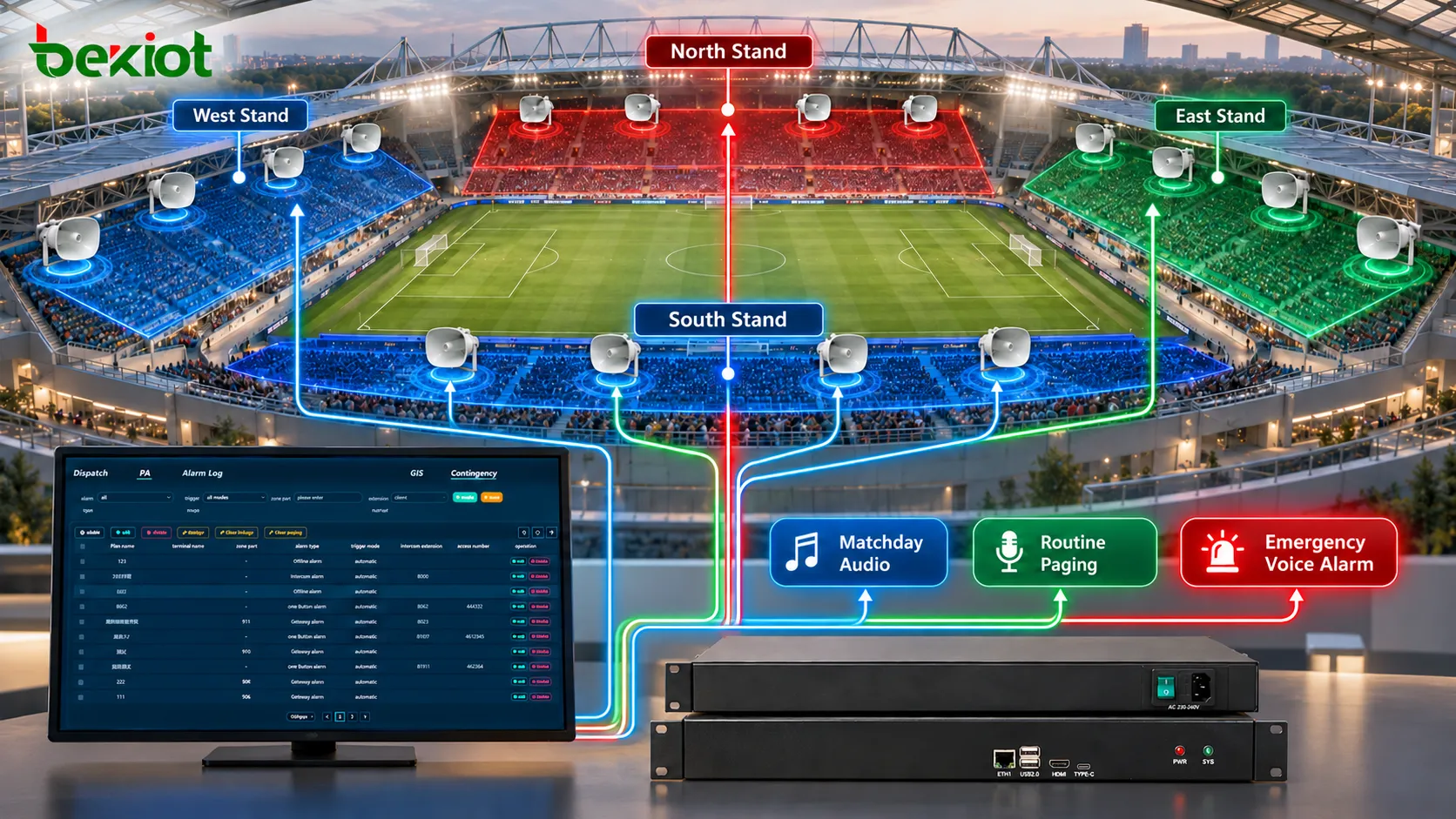
Conceptual stadium zone diagram showing separate announcement areas and emergency message routing
Illustrative zones, not Chesterfield FC’s verified paging or evacuation plan. Zone names, message priorities and activation rules must come from the venue’s approved design.

Distribution, Monitoring and Backup Must Be Assessed Separately

A 100 V loudspeaker distribution arrangement can be one option for an installed stadium system. Its suitability depends on compatible amplifiers and loudspeaker transformers, the connected load, cable losses and the required acoustic coverage. The distribution voltage does not, by itself, provide line supervision, battery backup or compliance with a voice-alarm standard.

Monitoring is a separate system function. The designer must identify which faults can be detected, where they are reported and what happens to unaffected circuits. A fault indicator at a rack is of limited operational value if the responsible staff cannot see it or do not have an agreed response.

Backup power needs the same end-to-end assessment. Battery-backed amplification is insufficient if an essential controller, microphone interface, network switch or audio source loses power. The required operating duration, load assumptions and battery condition must be established for the actual system. Whether batteries, a UPS or another arrangement are appropriate depends on the equipment architecture and project requirements.
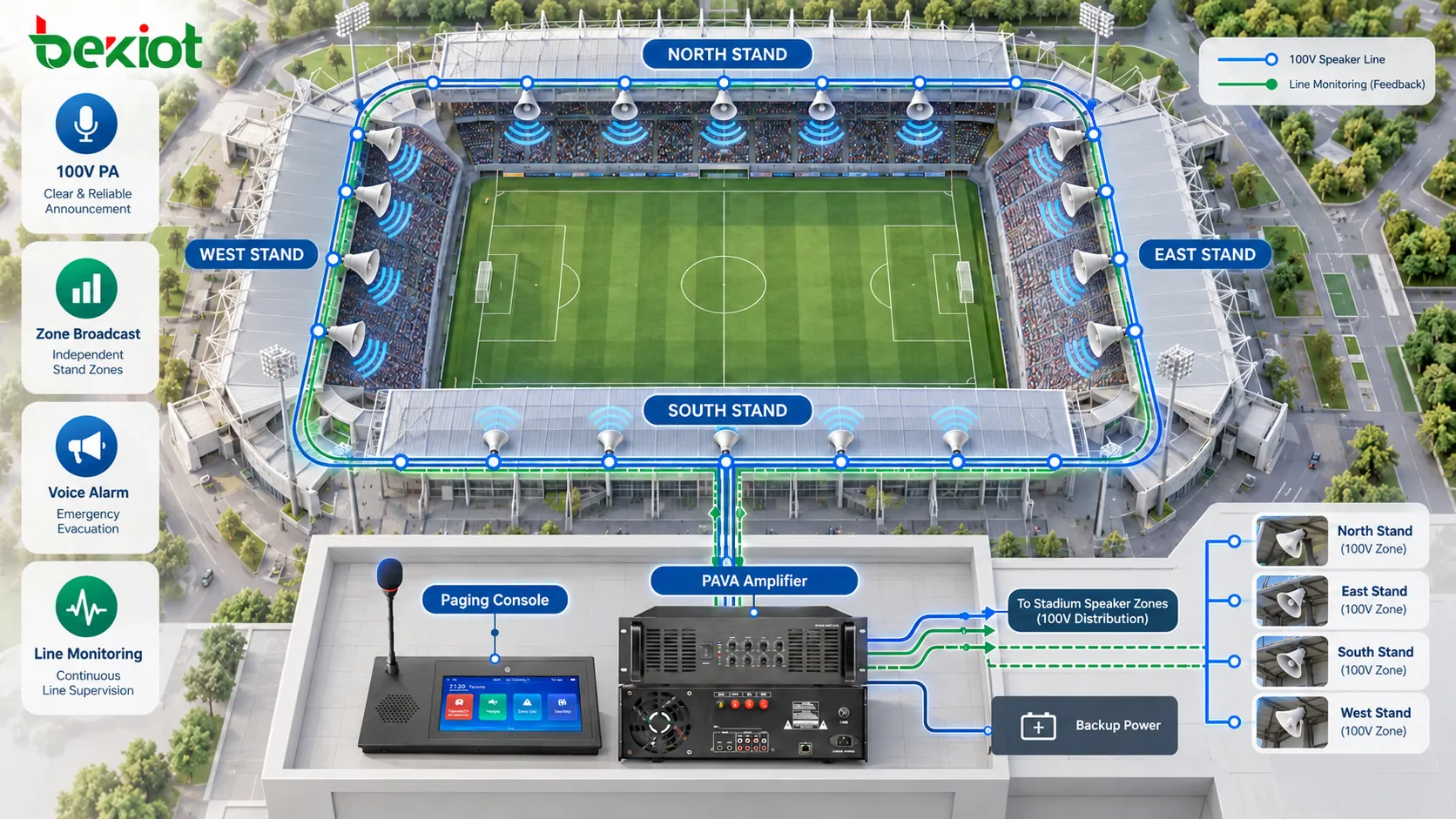
Conceptual stadium PA distribution diagram with amplification, loudspeaker circuits, monitoring and backup power
Concept diagram only. The coloured paths do not define a universal wiring method or prove that 100 V distribution includes fault monitoring. This is not an as-built drawing of the club’s system.

Acceptance Should Follow the Announcement to the Listener

A useful acceptance record connects an operator action with what people receive in the venue. For each agreed test, record the source, selected zones, operating mode, listening positions, expected result and observed result. Include both the areas that should receive the message and those that should remain unaffected.

  1. Check the operator controls. Confirm labels, permissions and the available announcement sources against the approved operating procedure.

  2. Verify destinations. Test individual zones and the required combinations. Confirm that temporary event inputs cannot unintentionally change the safety routing.

  3. Assess speech at representative positions. Include difficult seats and circulation areas. Use the project’s agreed acoustic assessment method and account for relevant background-noise conditions.

  4. Test the specified priority behaviour. Confirm what happens to music and routine paging during an authorized emergency announcement, and how normal operation resumes.

  5. Exercise approved fault scenarios. Under a controlled test plan, verify indications, remaining coverage and staff actions when a defined component or supply is unavailable.

These are planning and acceptance questions, not claims that particular tests were performed at Chesterfield FC. The club’s public statement establishes the supporter-facing improvement; a safety-performance conclusion requires the corresponding project evidence.

For venue teams, the practical value of a PA upgrade lies in predictable operation: understandable speech, correctly selected destinations, controlled priorities and known behaviour during faults. When discussing a stadium communication project with Becke Telcom, provide the zone schedule, existing audio interfaces and required operating scenarios so that any proposed integration can be assessed against actual requirements.

สินค้าแนะนำ
แคตตาล็อก
บริการลูกค้า โทรศัพท์
We use cookie to improve your online experience. By continuing to browse this website, you agree to our use of cookie.

Cookies

This Cookie Policy explains how we use cookies and similar technologies when you access or use our website and related services. Please read this Policy together with our Terms and Conditions and Privacy Policy so that you understand how we collect, use, and protect information.

By continuing to access or use our Services, you acknowledge that cookies and similar technologies may be used as described in this Policy, subject to applicable law and your available choices.

Updates to This Cookie Policy

We may revise this Cookie Policy from time to time to reflect changes in legal requirements, technology, or our business practices. When we make updates, the revised version will be posted on this page and will become effective from the date of publication unless otherwise required by law.

Where required, we will provide additional notice or request your consent before applying material changes that affect your rights or choices.

What Are Cookies?

Cookies are small text files placed on your device when you visit a website or interact with certain online content. They help websites recognize your browser or device, remember your preferences, support essential functionality, and improve the overall user experience.

In this Cookie Policy, the term “cookies” also includes similar technologies such as pixels, tags, web beacons, and other tracking tools that perform comparable functions.

Why We Use Cookies

We use cookies to help our website function properly, remember user preferences, enhance website performance, understand how visitors interact with our pages, and support security, analytics, and marketing activities where permitted by law.

We use cookies to keep our website functional, secure, efficient, and more relevant to your browsing experience.

Categories of Cookies We Use

Strictly Necessary Cookies

These cookies are essential for the operation of the website and cannot be disabled in our systems where they are required to provide the service you request. They are typically set in response to actions such as setting privacy preferences, signing in, or submitting forms.

Without these cookies, certain parts of the website may not function correctly.

Functional Cookies

Functional cookies enable enhanced features and personalization, such as remembering your preferences, language settings, or previously selected options. These cookies may be set by us or by third-party providers whose services are integrated into our website.

If you disable these cookies, some services or features may not work as intended.

Performance and Analytics Cookies

These cookies help us understand how visitors use our website by collecting information such as traffic sources, page visits, navigation behavior, and general interaction patterns. In many cases, this information is aggregated and does not directly identify individual users.

We use this information to improve website performance, usability, and content relevance.

Targeting and Advertising Cookies

These cookies may be placed by our advertising or marketing partners to help deliver more relevant ads and measure the effectiveness of campaigns. They may use information about your browsing activity across different websites and services to build a profile of your interests.

These cookies generally do not store directly identifying personal information, but they may identify your browser or device.

First-Party and Third-Party Cookies

Some cookies are set directly by our website and are referred to as first-party cookies. Other cookies are set by third-party services, such as analytics providers, embedded content providers, or advertising partners, and are referred to as third-party cookies.

Third-party providers may use their own cookies in accordance with their own privacy and cookie policies.

Information Collected Through Cookies

Depending on the type of cookie used, the information collected may include browser type, device type, IP address, referring website, pages viewed, time spent on pages, clickstream behavior, and general usage patterns.

This information helps us maintain the website, improve performance, enhance security, and provide a better user experience.

Your Cookie Choices

You can control or disable cookies through your browser settings and, where available, through our cookie consent or preference management tools. Depending on your location, you may also have the right to accept or reject certain categories of cookies, especially those used for analytics, personalization, or advertising purposes.

Please note that blocking or deleting certain cookies may affect the availability, functionality, or performance of some parts of the website.

Restricting cookies may limit certain features and reduce the quality of your experience on the website.

Cookies in Mobile Applications

Where our mobile applications use cookie-like technologies, they are generally limited to those required for core functionality, security, and service delivery. Disabling these essential technologies may affect the normal operation of the application.

We do not use essential mobile application cookies to store unnecessary personal information.

How to Manage Cookies

Most web browsers allow you to manage cookies through browser settings. You can usually choose to block, delete, or receive alerts before cookies are stored. Because browser controls vary, please refer to your browser provider’s support documentation for details on how to manage cookie settings.

Contact Us

If you have any questions about this Cookie Policy or our use of cookies and similar technologies, please contact us at support@becke.cc .