

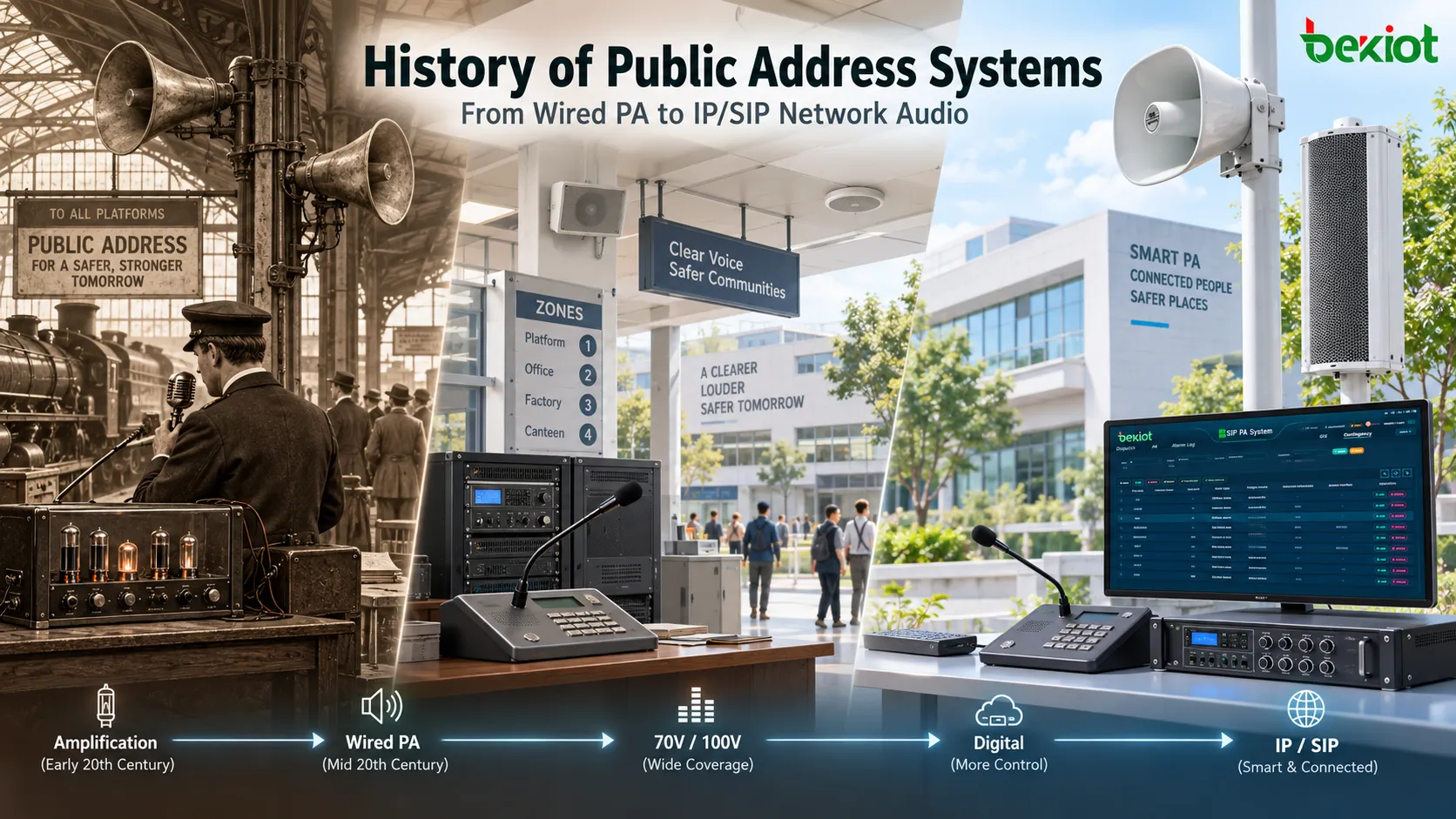
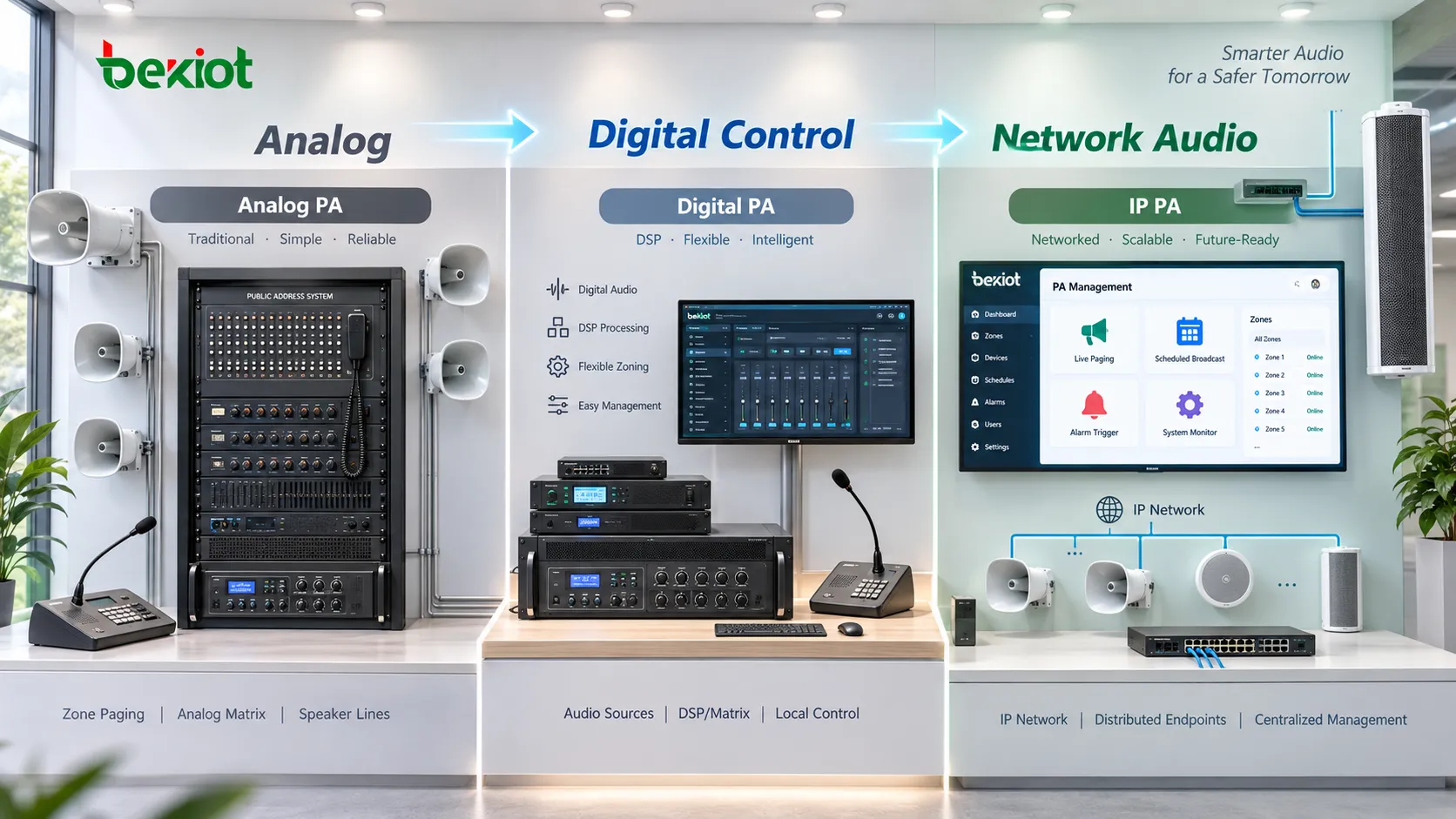
Public address developed through changes in amplification, distribution and control. A microphone and amplifier made a voice audible to more people; wired loudspeakers extended its reach; zoning allowed different areas to receive different messages. Digital processing and IP networking later made audio routing, scheduling and remote management more flexible.
These stages overlap. They are not a single worldwide replacement timetable, and wired broadcasting, concert sound reinforcement and building voice alarm have distinct histories. Today's systems often combine older loudspeaker circuits with modern control and network transport. The continuing aim is to deliver an intelligible message to the people who need it.
Electronic amplification and early wired public address
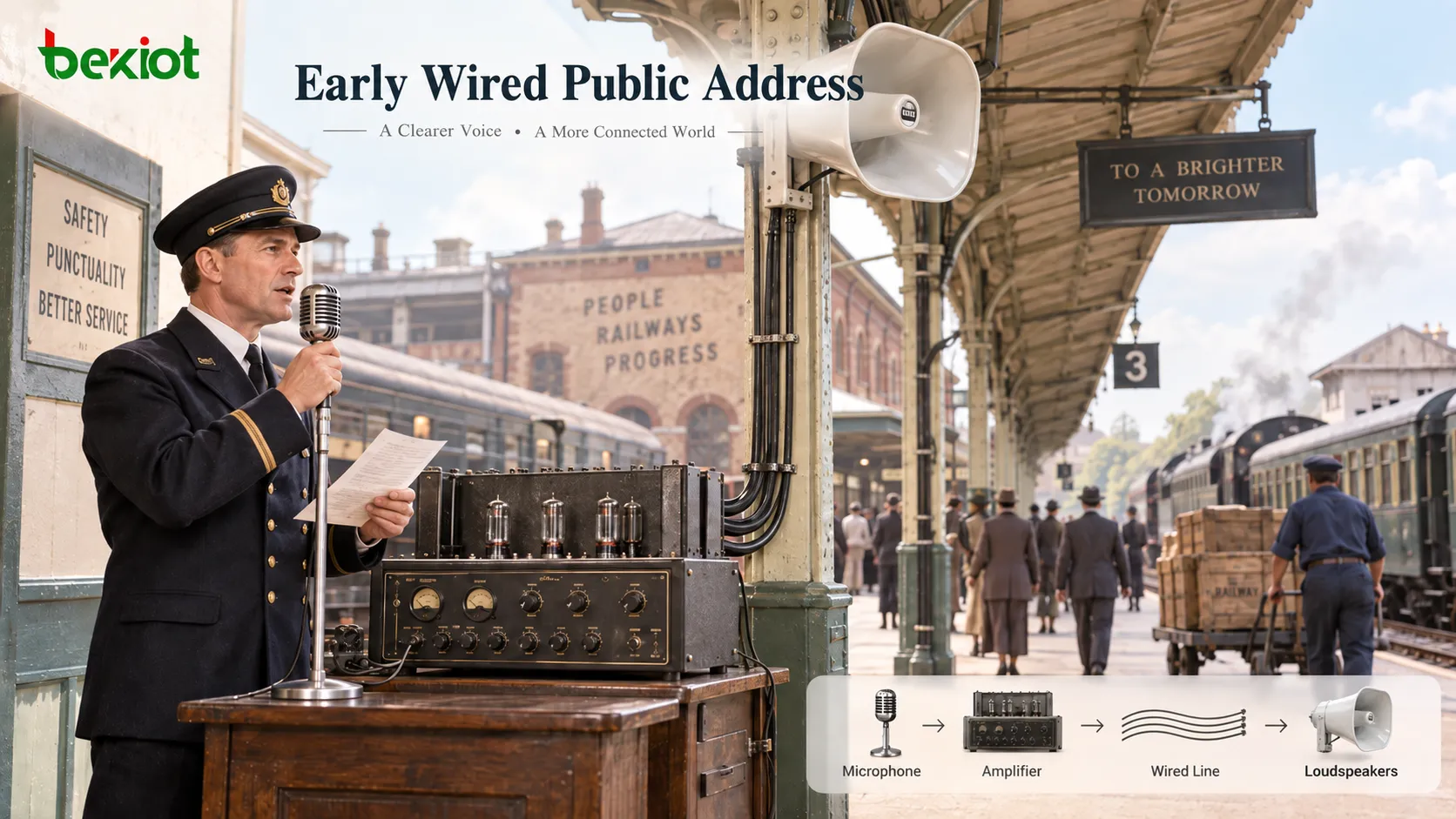
Before electronic amplification, bells, acoustic horns, speaking tubes and building acoustics helped extend sound, with limits on reach and intelligibility. Electroacoustic systems introduced a recognizable chain: microphone, amplifier, distribution cable and loudspeaker. The microphone converts sound into an electrical signal; the loudspeaker converts the amplified signal back into sound.
Early twentieth-century developments in microphones, loudspeakers and amplification enabled larger audiences to hear reproduced speech and music. Valve amplifiers and horn loudspeakers became part of early sound systems. One documented example of the period is the Science Museum's exponential horn, designed in 1929 and demonstrated in its galleries from 1930 to 1939. It illustrates contemporary loudspeaker development, rather than establishing a single invention date for all PA systems.
A centralized source could feed loudspeakers at several locations over cable. This created the enduring arrangement of a control point, transmission infrastructure and distributed acoustic endpoints. Railway stations, factories and public venues could use such systems for information and operational announcements. Coverage still depended on loudspeaker placement, background noise, reverberation and the available amplifier power.
China's wired-broadcasting experience
China's rural wired-broadcasting networks provide an important example of centralized audio distribution serving a public-information role. They carried programs and announcements to loudspeakers in communities, schools and production areas. This use shared components with PA, but a rural broadcasting network should not be treated as identical to a building paging or fire voice-alarm system.
A dated example is Jiutai County in Jilin. The Jilin provincial local-history authority records the establishment of its rural wired broadcasting station on 1 April 1952, initially serving 330 loudspeakers at places including local government offices, schools and cooperatives. This is a documented local milestone; it does not mean that electronic public address in China began on that date.
As schools, transport facilities, hotels and industrial sites required more selective announcements, the same practical questions arose in China and elsewhere: which area should receive a message, which source has priority, and how can failures be detected? Application histories differed between places, while many engineering requirements converged. Avoid treating every country outside China as one uniform development path.
Constant-voltage distribution: connecting many loudspeakers
Long cable runs are difficult when loudspeakers require high current. For a given delivered power, a higher distribution voltage allows lower current and therefore less resistive cable loss. In a typical 70V or 100V distributed system, an amplifier feeds a loudspeaker line and transformers at the loudspeakers provide suitable loading and selectable power taps.
The term constant voltage describes the nominal full-output distribution system; the audio waveform is not a fixed DC voltage and does not remain at 70V or 100V during every message. Designers must add the selected loudspeaker tap loads, allow appropriate amplifier capacity and cable-loss margins, and follow the equipment's permitted loading and installation requirements.
The signal chain is audio source, control or preamplification, distribution amplifier, speaker line and multiple loudspeakers. This architecture makes local multi-speaker coverage practical, but one line still cannot independently carry a different program to each passive loudspeaker connected to it. Selective announcements require separate circuits, switching or another suitable control arrangement.
From all-site announcements to zoning and matrices
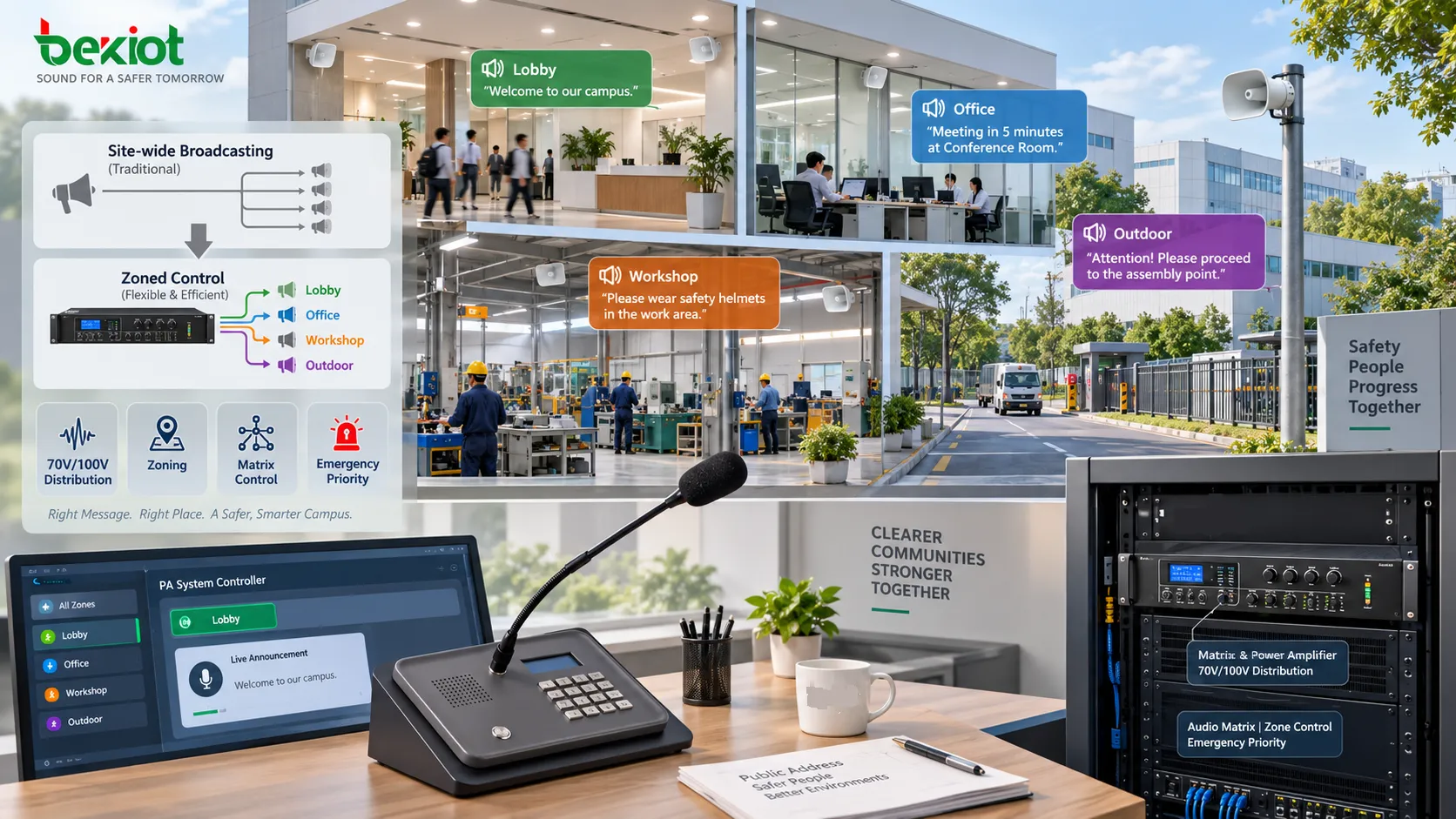
Zoning divides coverage into functional areas such as offices, workshops, warehouses, platforms, parking areas and outdoor roads. An operator can address one area, several areas or the whole site. A hotel lobby can receive music while a station waiting area receives passenger information; these tasks need not interrupt every other space.
With more sources and zones, audio matrices provide controlled routing from inputs to outputs. Paging microphones, zone selectors and multi-channel amplification support different combinations of messages and destinations. Multiple simultaneous programs require enough independent signal paths and amplifier channels; adding a zone label alone does not create additional audio capacity.
Emergency voice changes the design obligation
A routine PA system is not automatically a compliant voice-alarm system. Emergency use can require supervised circuits and equipment, standby power, fault indication, controlled access and intelligibility assessment, according to the application and local rules. Emergency messages commonly override routine audio, but the exact priority sequence and evacuation zones must follow the approved cause-and-effect design.
IEC 60268-16:2020 addresses objective speech-intelligibility rating using the Speech Transmission Index. Its published scope explicitly says that it does not set certification criteria for voice-alarm transmission channels. An STI measurement, an IP connection or a SIP feature therefore cannot by itself demonstrate emergency-system compliance. Appropriate design, installation and acceptance requirements still apply.
Digital sources, DSP and software control
Digitalization first changed how audio was stored, processed and selected. CDs, audio files and computer playback could replace mechanical media and manual program selection. Scheduled bells, playlists and prerecorded announcements became easier to organize, although dependable operation still required correct schedules, permissions and suitable fallback arrangements.
Digital signal processing can provide equalization, gain control, delay, mixing and dynamics processing. Digital matrices can route sources and configure relationships between zones in software. A digital source and DSP controller can still feed conventional amplifiers and 100V speaker lines; digital processing does not require every loudspeaker to be an IP endpoint.
That distinction separates two changes often confused in PA history. Digital processing concerns audio representation and manipulation. IP networking concerns packet transport between networked devices. Either can exist without replacing the entire final loudspeaker circuit, and neither eliminates the need for acoustic design.
IP networking changes long-distance transport
A conventional building system may connect a central matrix and amplifier rack to zones over long speaker cables. An IP design can transport encoded audio over a data network to a local network amplifier, audio interface or active loudspeaker. The remote equipment decodes the stream and provides the local audio output.
An illustrative chain is PA server or audio source, Ethernet/IP network, receiving endpoint and local loudspeaker coverage. A server is not mandatory in every design: some architectures support direct endpoint communication. Network capacity, codec support, clocking where applicable, multicast or unicast behavior, packet loss and latency must match the chosen implementation.
Logical groups and simultaneous audio tasks
Network endpoints can be assigned to logical groups by building, floor, workshop or operational role. Software changes can alter membership without moving every cable, but the loudspeakers behind one analog amplifier output still share that circuit's signal. Physical coverage boundaries and emergency zones remain important even when control is software-defined.
Several network streams can serve different areas at once, such as music in an office and live instructions in a warehouse. Actual concurrent-stream capacity depends on the server, network, decoders and output channels. Bandwidth, multicast configuration and priority handling require verification; IP alone does not guarantee independent audio in every zone.
Remote management and its limits
Supported endpoints can report connectivity and equipment faults to a central platform. Configuration, software maintenance and site administration can be performed remotely where permitted. An online indication, however, does not prove that a speaker is audible, a cable is intact or speech is intelligible at the listener's position. Supervision coverage and local acoustic checks remain necessary.
SIP links paging with telephony and intercom
SIP, standardized in RFC 3261 in June 2002, establishes, modifies and terminates multimedia sessions. In a compatible deployment, a telephone or dispatch console can call a paging endpoint. Audio commonly travels through a separate media mechanism such as RTP. SIP is signaling; it does not by itself define loudspeaker wiring, acoustic coverage or every paging priority rule.
An industrial worker may call a control room through an intercom, after which the dispatcher selects a paging group and speaks to that area. A SIP paging gateway can connect a compatible calling platform to existing amplifier inputs. The gateway's audio levels, call authorization, relay behavior and zone controls need verification against the equipment at both ends.
Two-way communication requires a microphone, return audio and supporting call control; a one-way loudspeaker does not gain these functions merely by using SIP. Alarm-triggered messages, call recording, automatic zone selection and dispatch workflows may reside in a platform, gateway or custom integration. Each must be tested rather than inferred from protocol support.
SIP is useful where paging must coordinate with phones, intercoms and dispatch. A small music-and-announcement system may not need it. For a broader view of system components and applications, see the public address system guide. Compatibility and operational purpose should determine the architecture.
Why 100V loudspeaker circuits remain useful
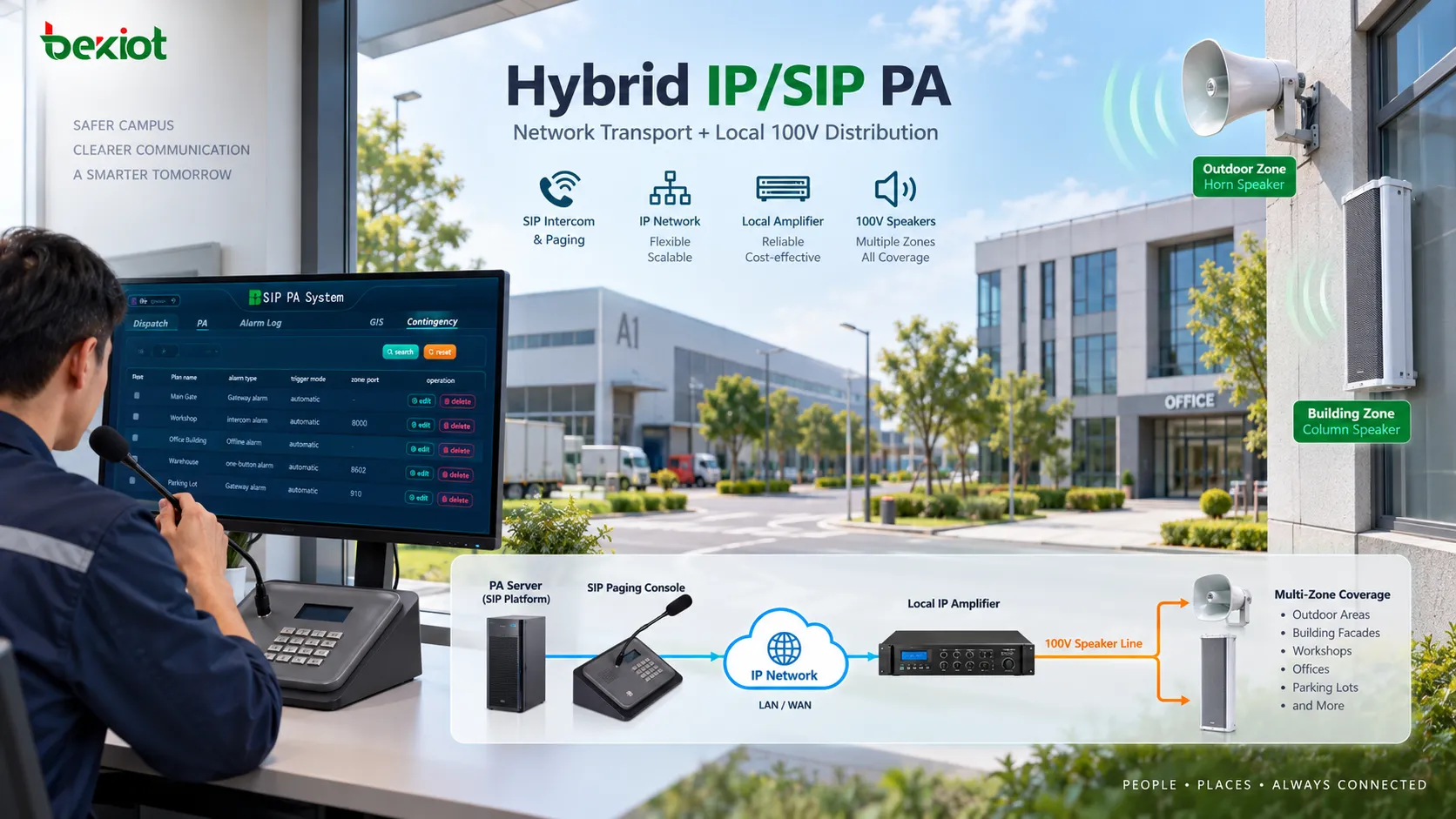
IP transport and constant-voltage distribution solve different parts of the system. A network can move audio between buildings or sites, while one local amplifier can distribute it to many passive loudspeakers. A hybrid arrangement is PA source or server, IP network, local IP amplifier, 100V speaker line and multiple loudspeakers.
Direct IP loudspeakers may suit individually controlled locations. A local amplifier and distributed circuit may suit a zone containing many horns, columns or ceiling speakers. The choice depends on cabling, power, supervision, control granularity, maintenance and cost. A hybrid design is not automatically cheaper or safer; it must be assessed for the actual site.
What the historical changes mean for current projects
PA history is best understood as overlapping developments: electrical amplification, wired distribution, constant-voltage loudspeaker circuits, zoning and matrices, digital processing, network transport and communications integration. New control methods often reuse existing acoustic equipment. Amplifiers and loudspeakers remain necessary even when their packaging and location change.
For current projects, identify where audio originates, how it reaches each zone, who can interrupt it, what failures are supervised and what survives a loss of power or network service. Becke Telcom's IP PA system overview describes network paging and integration options; functions and any emergency-use requirements must be confirmed for the specified equipment and deployment.
FAQs
Are public address and radio broadcasting the same?
No. PA generally serves defined listening areas through installed loudspeakers, while radio broadcasting transmits programs to radio receivers. China's wired-broadcasting history overlaps with public audio distribution, but its networks and purposes should not be equated with every building PA system.
Does digital PA always mean IP loudspeakers?
No. Digital sources, DSP and software-controlled matrices can feed conventional amplifiers and 100V loudspeaker circuits. IP audio adds network packet transport between suitable devices; it is a separate architectural choice.
Does SIP make a PA system two-way or suitable for evacuation?
No. Two-way audio needs suitable microphones, return paths and call functions. Evacuation use requires the applicable system design, supervision, power and compliance measures. SIP compatibility alone supplies neither result.
Will IP replace every 70V/100V loudspeaker line?
There is no technical requirement for that outcome. Network transport and local constant-voltage circuits can coexist. Individual control, cable routes, power, fault supervision and operating needs determine whether direct IP, conventional or hybrid distribution is appropriate.
References
IETF RFC 3261, June 2002 — the scope and operation of SIP session signaling.