

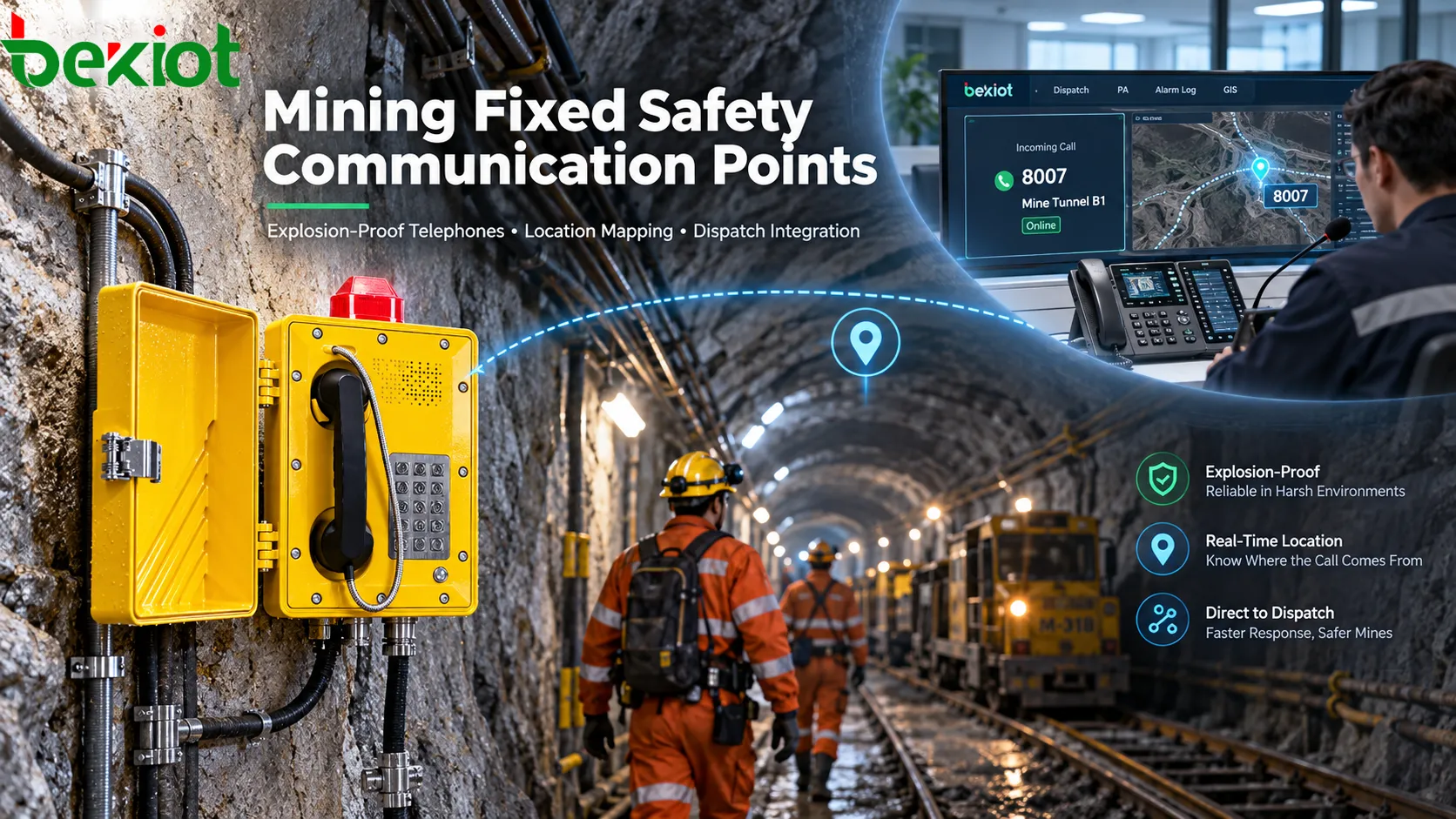
A fixed mine telephone gives workers a known place to call the surface when personal radios are unavailable or coverage changes. Its value depends on suitable explosion protection, reachable placement, accurate location records and a working path to an attended dispatch position. A rugged enclosure alone cannot guarantee communication during an accident.
Start with Mine Hazards and the Applicable Approval
“Mining explosion-proof telephone” is a broad purchasing description, not a universal certification. Identify the mine type, firedamp and combustible-dust risks, installation location, national mining rules and the equipment approval accepted by the authority. A metal mine, a gassy underground coal mine and a surface processing plant can require different equipment.
Group I Is Different from Group II
Under the ATEX equipment-group framework, Group I concerns underground mines and associated surface installations endangered by firedamp and/or combustible dust; Group II concerns other potentially explosive locations. Mining categories M1 and M2 have different protection and operating conditions. M2 equipment is intended to be de-energized when an explosive atmosphere is present. Do not assume a telephone may remain energized after a gas shutdown.
A non-mining gas marking such as IIC T6 is not evidence of Group I mining suitability. Do not substitute an IP rating, a yellow enclosure or the word “Ex” for the required mining approval. National approval and installation requirements must be checked even when equipment has an international certificate.
IEC 60079-14:2024 covers Ex electrical installation design, selection, installation and initial inspection, but its published scope expressly excludes electrical installations in mines susceptible to firedamp. It must not be presented as a complete installation rule for those mines. Use the mining-specific rules and approved design applicable to the jurisdiction.
| Selection check | Evidence to verify |
|---|---|
| Hazard and jurisdiction | Mine assessment, required mining approval and permitted installation location. |
| Exact supplied equipment | Model, certificate or approval number, schedule, accessories and any special conditions. |
| Operating boundary | Protection concept, ambient range, power source and permitted behavior during gas alarms or shutdown. |
| Installed system | Approved cable entries, wiring, associated apparatus and maintenance instructions; IP/SIP or PoE alone establishes no intrinsic safety. |
For non-mining gas and dust marking terminology, see the guide to reading explosion-proof telephone nameplates. Mining acceptance still requires the correct mining documentation.
Keep Fixed and Mobile Communication Complementary
Wireless networks support moving inspection teams, but depend on coverage, antennas, base stations, backhaul, power and carried terminals. A radio can be damaged, discharged, absent or difficult to operate after injury. A fixed point remains at its assigned location and can serve workers who have no usable personal terminal.
Evaluate electrical chambers, pump stations, haulage and hoisting points, working-face approaches, refuge locations and staffed posts. Fixed phones can provide another access method, but they are not automatically independent of wireless service: both may share a switch, fiber route, power supply or dispatch server.
Design Survivability, Location Mapping and Direct Dispatch Together
Avoid Common Failure Points
Trace the complete path from each underground telephone through cabling, access equipment, core switching and power to the surface operator. Identify failures that could remove several critical points together. Protect routes and equipment, provide suitable backup power and consider diverse links or alternate communication methods where the risk assessment requires them.
Redundancy must be physically meaningful. Separate logical networks on one damaged fiber or two supplies connected to one unprotected source may fail together. Record which services remain after each credible fault and which are lost. No design should claim that a fixed telephone is always available after collapse, fire or flooding.
Maintain the Identity-to-Location Relationship
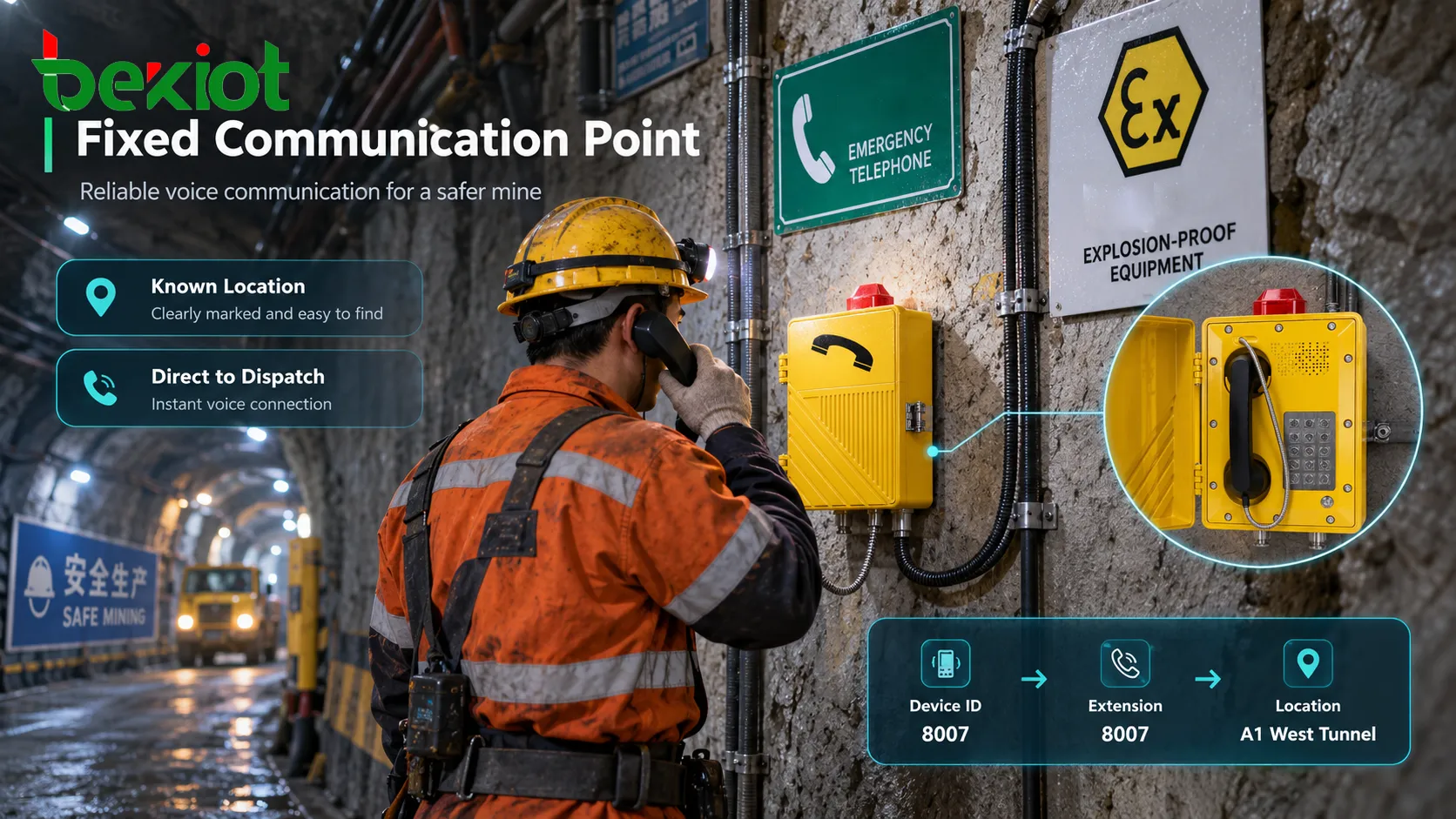
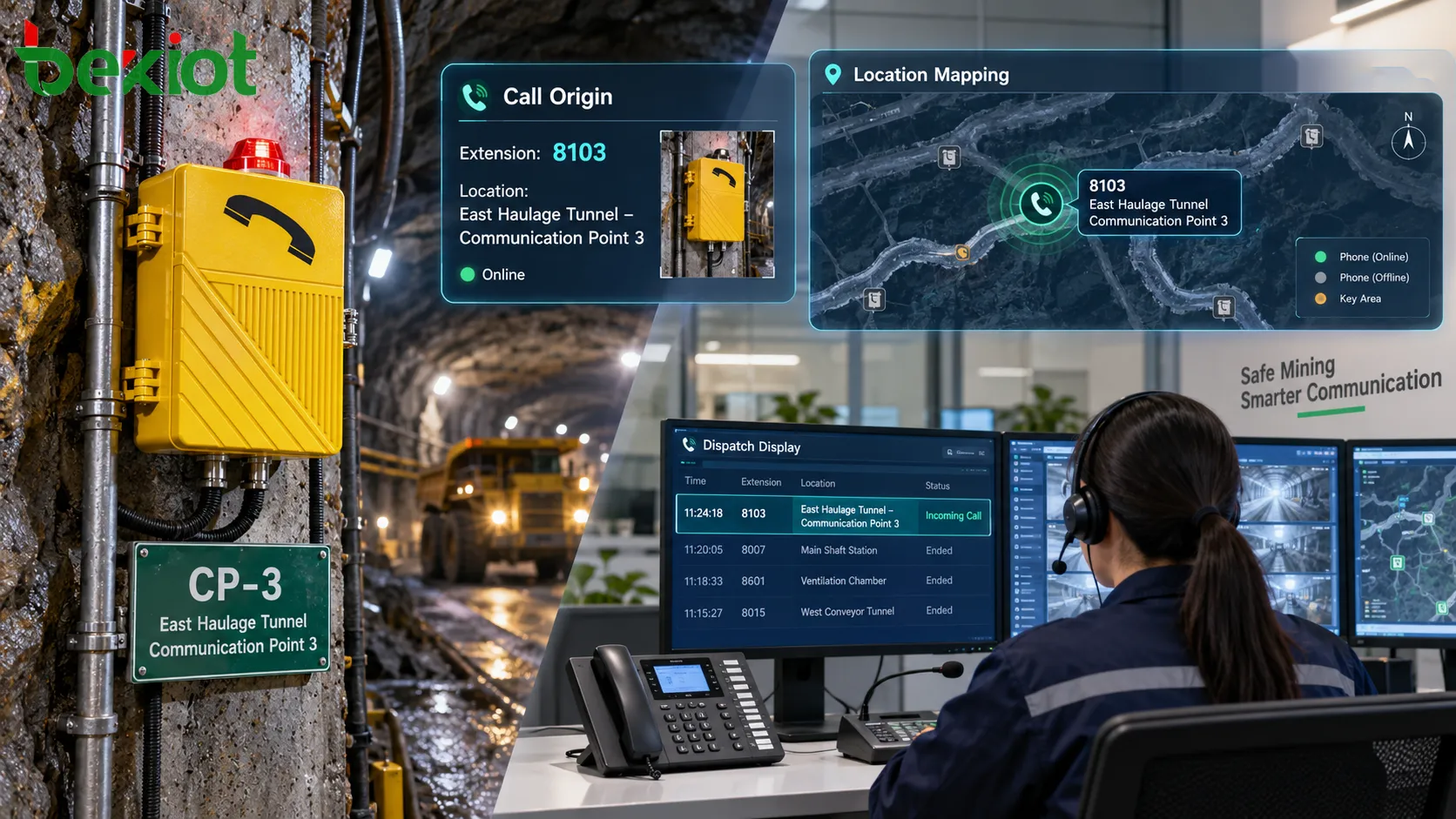
Keep a consistent asset record: device ID → telephone number → installation location → line or network port → dispatch display name. An extension such as “8103” should map to a useful description such as “East Haulage Tunnel – Communication Point 3.”
The display identifies the registered call point, not necessarily the casualty's location or a live personnel-tracking position. Dispatchers should confirm the event location whenever possible. Update records, signage, maps and console configuration whenever faces advance, tunnels close or telephones move.
Simplify Calling and Escalation
Where supported and approved, use an off-hook hotline, preset destination or emergency key to reach an attended surface position. Define busy handling, unanswered-call escalation, priority and callback. Platform queues, location display, recording and radio or paging coordination require compatible configuration or integration; they are not guaranteed by a telephone's SIP support.
Implement the Complete Underground-to-Surface Workflow
First, locate communication points around actual work, travel, refuge and escape arrangements. Next, select a maintainable transmission path: dedicated telephone cabling or a suitably approved IP/SIP arrangement. Analog gateways, network equipment, power and associated apparatus must be included in the safety and compatibility review.
A practical response sequence is: underground call → dispatch displays the call-point location → operator confirms the incident and caller's position → appropriate teams are contacted → authorized wireless coordination or zone paging is used where required → calls and actions are recorded where configured.
Fixed voice, mobile coordination and one-to-many paging serve different tasks. A telephone installation does not by itself satisfy every post-accident communication or tracking obligation. For example, U.S. underground coal mines have specific requirements under 30 CFR Part 75, Subpart Q, including communication facilities for refuge alternatives, alongside the approved emergency-response arrangements. Those provisions are jurisdiction-specific.
Choose Placement and Backup Capacity from the Mine Plan
There is no universal spacing rule for every mine. Apply any binding local distance and placement requirements first, then assess how far workers must travel, physical barriers and what remains if wireless coverage is lost. Two tunnels of equal length can have different occupancy, equipment and evacuation risks.
Review working and inspection routes, advancing faces, substations, pumps and haulage points.
Check refuge and escape arrangements, weak-coverage areas and safe access to each terminal.
Review shared failure points, protected routes and the actual runtime of backup supplies under load.
Reassess positions and records after layout, production or communication-system changes.
Backup power must support the required service without defeating explosion protection or a mandated shutdown. Select approved supplies, batteries and associated equipment for the intended location and operating conditions. Longer battery runtime does not authorize continued operation in a prohibited atmosphere.
Verify Real Calls and Controlled Failure Conditions
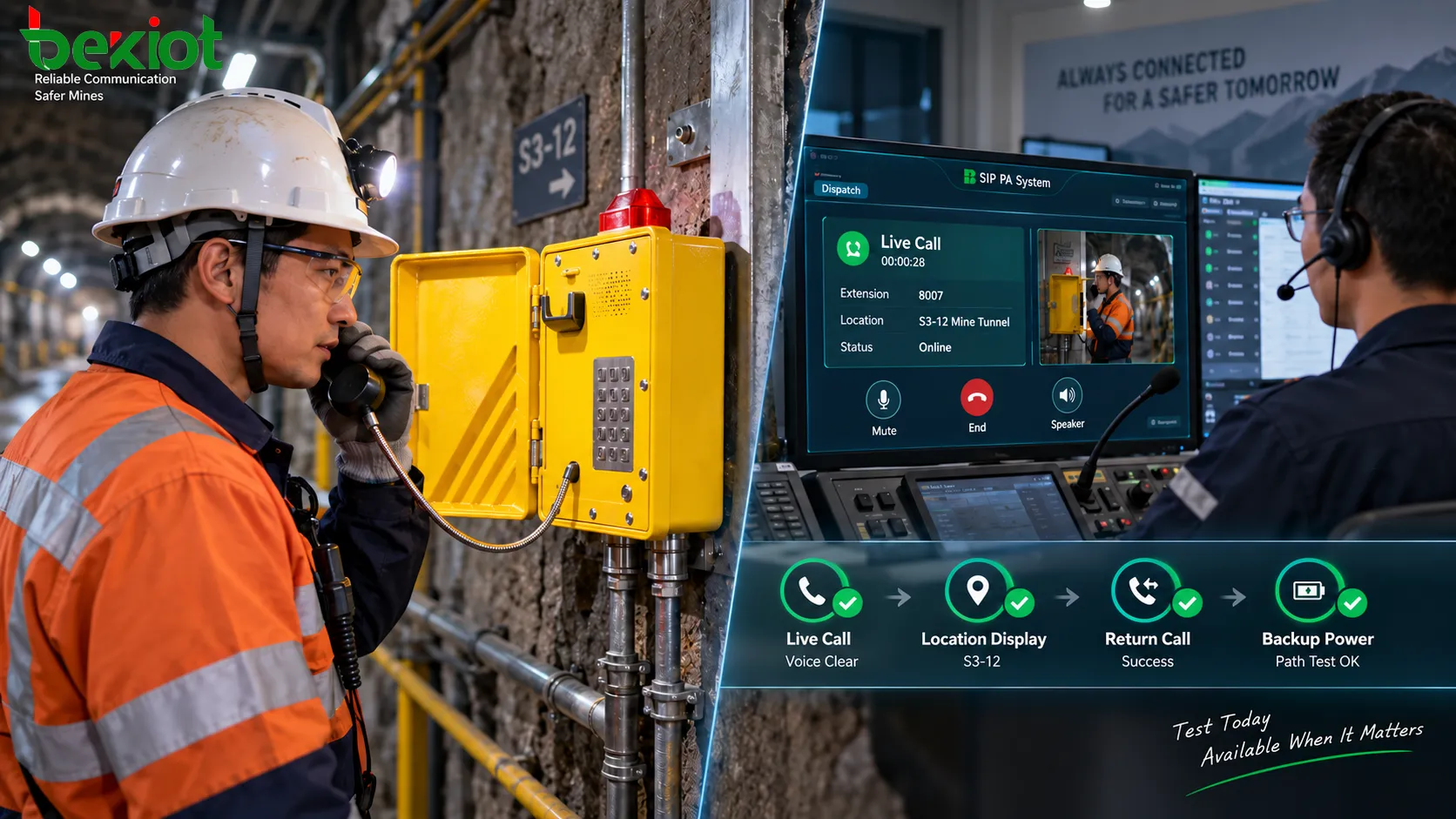
Inspect mounting, enclosure integrity, labels, cable entries, connections, cords, off-hook detection, keys and alerts using the approved maintenance method. Do not open or modify Ex equipment contrary to its instructions or mine procedures. Test two-way speech in operating noise with required PPE and an incoming callback detectable by the intended users.
Place an actual call to dispatch and verify the displayed number and location. For IP equipment, “Online” or “SIP Registered” proves only part of the system; microphones, receivers, RTP paths, routing and the operator position can still fail. Check the approved gateway path as well where analog terminals are retained.
Plan authorized power, link and server failure tests without disabling required mine protection or emergency coverage. Verify transfer to backup, specified runtime, alarms, fallback destinations and recovery after restoration. Keep test records and retest after relocation, repairs or configuration changes.
For projects considering Becke Telcom equipment, establish the required mine approval, supplied configuration and integration scope before selection. No model-specific mining approval or survivability claim is established by this article.
FAQs
Does an IIC T6 marking prove suitability for a gassy mine?
No. It describes aspects of a non-mining gas approval. Check the required mining group, exact approval, operating conditions and national acceptance for the installation.
Can a fixed phone replace wireless emergency communication?
It can complement mobile coverage and provide known call points, but it does not automatically replace communication or tracking measures required by the mine's approved emergency plan.
Does the location display identify an injured worker?
It identifies the mapped calling terminal. The caller or casualty may be elsewhere, so the dispatcher should confirm the incident location when possible.
Does SIP registration prove readiness?
No. Test the real two-way call, alert, callback, location record and required fallback behavior through the complete approved system.
References