

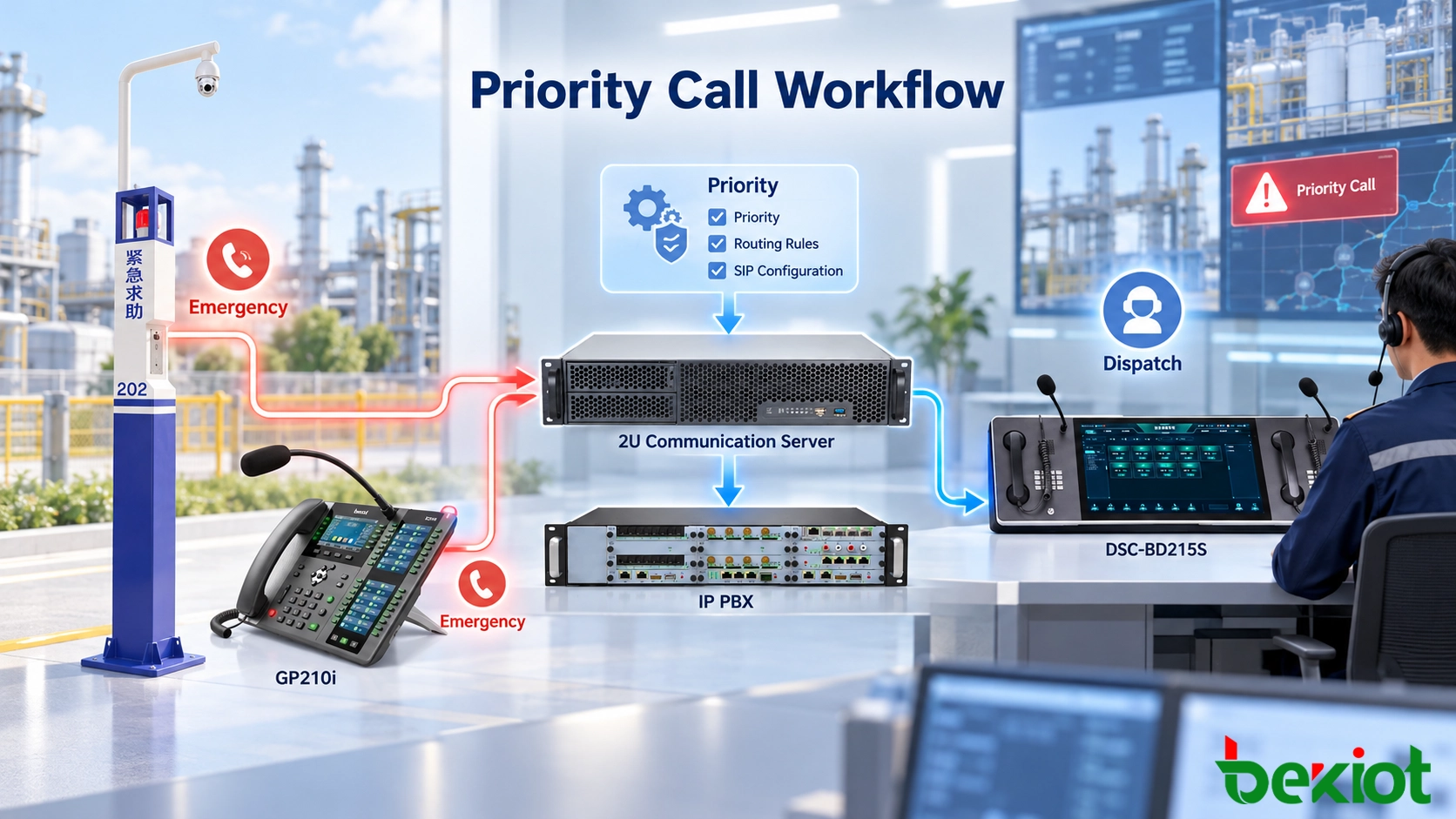
A routine assistance call and an urgent incident may reach the same control room while every operator is already busy. Configuring priority means deciding how the system recognizes the urgent request, which resources it may use and what happens to other calls. Marking an intercom as “emergency” is only one possible input to that decision.
Priority calling depends on the endpoint, PBX or dispatch platform, network and response procedure. The configuration below is a design sequence for a site-managed SIP system, not a universal product menu. Confirm each function against the selected device firmware, platform version and supported integration before enabling it.
Understanding Priority Calls in SIP Emergency Communication
First separate the behaviors that a priority setting might control. Several can be useful together, but they solve different problems.
| Behavior | Purpose | Configuration owner |
|---|---|---|
| Routing and presentation | Send an identified call to a particular response group and show its urgency | Call platform and operator application |
| Queue order | Select which waiting request is served when capacity becomes available | Queue or dispatch service |
| Call admission | Decide whether a new call can use a limited trunk, media resource or service capacity | The component controlling that resource |
| Preemption | Displace an established lower-priority session to release a required resource | A supported session or resource controller |
| Network QoS | Apply the intended forwarding treatment to signaling and media packets | Network devices and their trust policies |
A site might classify calls as emergency, security and routine assistance. Those are example operating categories, not standardized SIP precedence levels. Define who may use each category, what it changes and how equal-priority requests are handled. A high-priority call still needs an available response path and people able to act on it.
Priority Assignment at the Device Level
Document each intercom's account, physical location, button function and destination. A dedicated emergency terminal can be mapped to a server-side policy without requiring the terminal to transmit a special priority header. Conversely, an endpoint that can send a priority value still depends on the receiving system to recognize and authorize it.
Location alone should not determine every decision. A production-area device might support both routine and emergency calls, while a public help point may have only one assistance button. Configure the permitted trigger and identity mapping to match the operating procedure, and prevent ordinary accounts from obtaining elevated treatment simply by changing a display name or supplied header.
Configuring SIP Emergency Call Priority and Routing Rules
1. Establish the Emergency Identity and Entitlement
Create or verify the endpoint account and map it to a maintained location record. Record the allowed call category and the basis on which the platform trusts that classification. Keep authentication of the caller separate from authorization to request a particular resource priority.
2. Define Primary and Backup Response Destinations
Select the staffed response group, the alternate duty group and the conditions for moving between them. Busy, no answer, unavailable service and rejected authorization are different outcomes; they should not all cause an uncontrolled redial loop. Set an agreed waiting limit and a final action when all permitted destinations are exhausted.
For example, an industrial help point could call its local control room, then an authorized central duty group if no one answers within the project's agreed interval. This is a routing policy. It does not imply that the call can seize a busy console, interrupt another conversation or survive failure of the shared PBX.
3. Choose How Priority Is Represented
The SIP Priority header in RFC 3261, Section 20.26, conveys the request's urgency to the recipient or its agent. It may inform routing or acceptance, but it does not allocate communication resources or change router forwarding. Sending Priority: emergency therefore does not establish preemption or privileged network access.
RFC 4412, Sections 3–4 and 11.2, defines the separate Resource-Priority extension. Participating elements need a recognized namespace, understood priority values and authorization policy. Its resource treatment can involve priority queues or preemption; it does not directly configure IP routers. A private PBX's numbered priority setting is not automatically an RFC 4412 value or a government priority-service entitlement.
Choose the mechanism actually supported by the project: authenticated extension rules, a documented platform category, supported Resource-Priority signaling, or an explicitly defined mapping between systems. Capture a test call at the relevant boundaries to confirm that the intended classification survives forwarding and any gateway or back-to-back user agent.
4. Specify the Resource Decision
Record the intended behavior for an available resource, a busy resource, an exhausted queue and an unavailable destination. Name the component that enforces each rule. Avoid configuring several independent retry and escalation engines unless their interaction has been designed and tested.
Priority Call Preemption and Emergency Override Mechanisms
Normal Call Handling
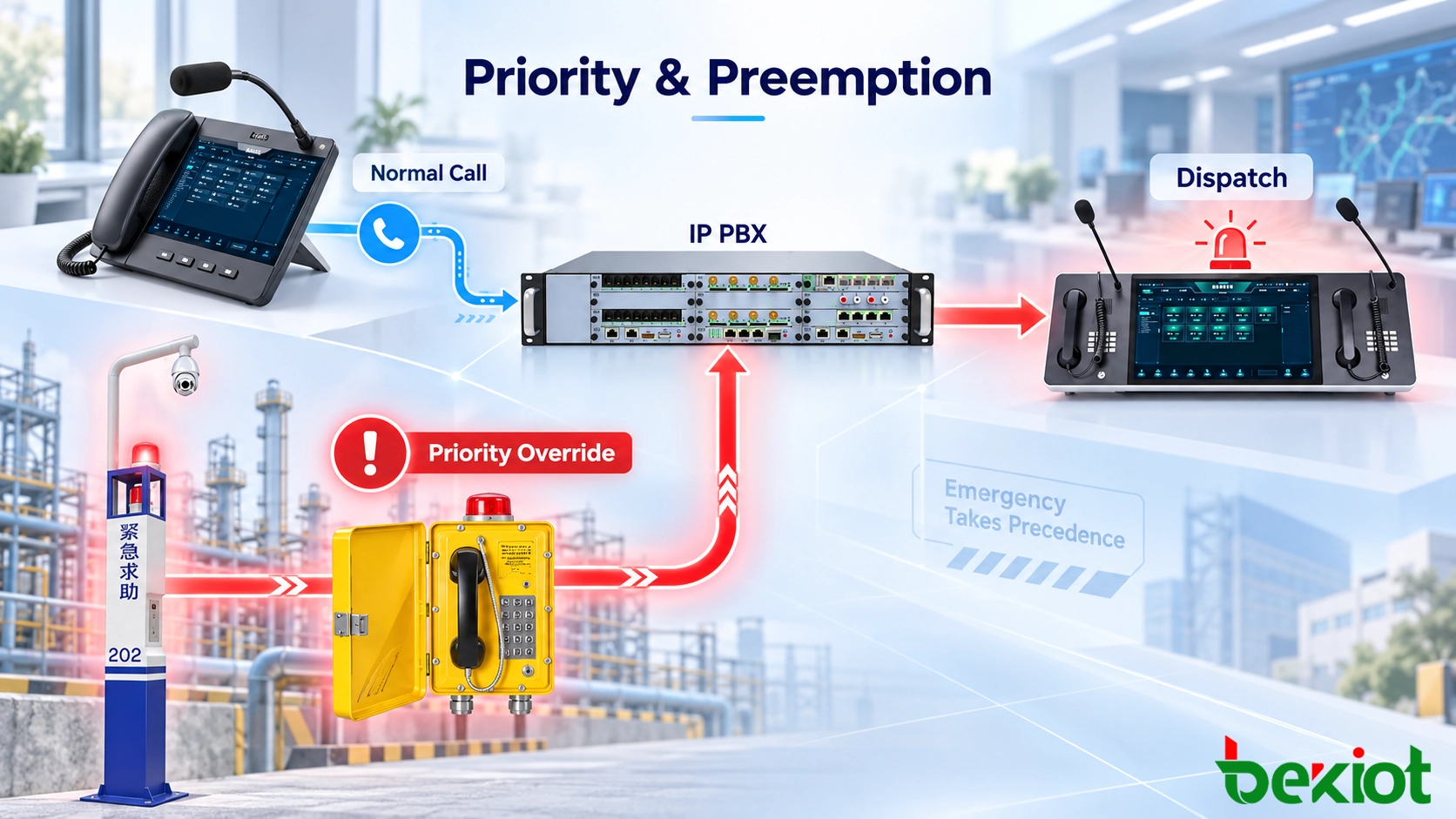
With capacity available, a priority call may simply reach its assigned response group. When capacity is occupied, an implementation might queue the request, present call waiting, seek another operator or reject it. None of those outcomes alone demonstrates preemption.
When Preemption Is Required
RFC 4412 Section 4.5.1 describes preemption as disrupting an existing session to make room for a higher-priority session. A SIP proxy that only forwards signaling does not itself manage sessions and cannot perform that function. The project needs a supported controller for the affected endpoint, session or gateway resource.
Before enabling preemption, agree which sessions may be displaced, which emergency conversations are protected, how users are notified and what happens afterward. Putting a routine call on hold may free an operator's attention while leaving trunks or media resources occupied. If the requirement is to release a specific resource, confirm that the chosen action actually releases it.
| Operating condition | Policy decision to document |
|---|---|
| Routine call occupies the required resource | Queue, alternate route or authorized preemption, with an observable outcome for the routine caller |
| Another emergency call is active | Protection rules and the treatment of a second call at equal or higher priority |
| No eligible session can be displaced | Waiting, rejection or a designated alternate response path |
| Call crosses a platform or gateway boundary | Supported classification mapping and which system controls the constrained resource |
These are engineering decisions for the site's approved procedure. Do not infer interruption authority from a red alert on the console. Operator barge-in and manual forced release are also separate functions, described in the voice dispatch call-control overview.
Integrating Priority Calls with IP PBX and Dispatch Platforms
The PBX may own destination selection and call admission, while a dispatch application owns operator queues, alarms and incident records. Confirm the division of responsibility: a console that displays several incoming calls does not necessarily support simultaneous conversations, priority admission or session preemption.
At the operator interface, distinguish ringing, queued, connected, escalated and failed requests. Show the calling location and the action currently expected of the operator. Multi-level response can then follow location, incident category, duty schedule and availability without silently bypassing a required acknowledgment.
Where multiple sites or platforms cooperate, document category mapping in both directions. Test the route with the actual gateway and software versions. Local priority numbers need not have the same meaning elsewhere, and optional signaling can be unsupported by an intermediate component. Record the fallback behavior rather than assuming priority survives every boundary.
Deployment Considerations for Reliable Priority Communication
Network Design and Quality Management
Network QoS supports packet delivery; call priority supports application decisions. RFC 4594, Sections 4.1–4.2, provides informational guidance distinguishing telephony media from signaling traffic and discusses engineered capacity and admission. It is not a universal emergency-call guarantee or a ready-made policy for every network.
Validate classification and forwarding across the complete managed path, including gateways and any provider boundary. Size the design for its required simultaneous calls and video traffic. VLAN separation alone does not reserve bandwidth, and redundancy must be checked for shared switches, uplinks and power supplies.
Industrial Environment and Equipment Selection
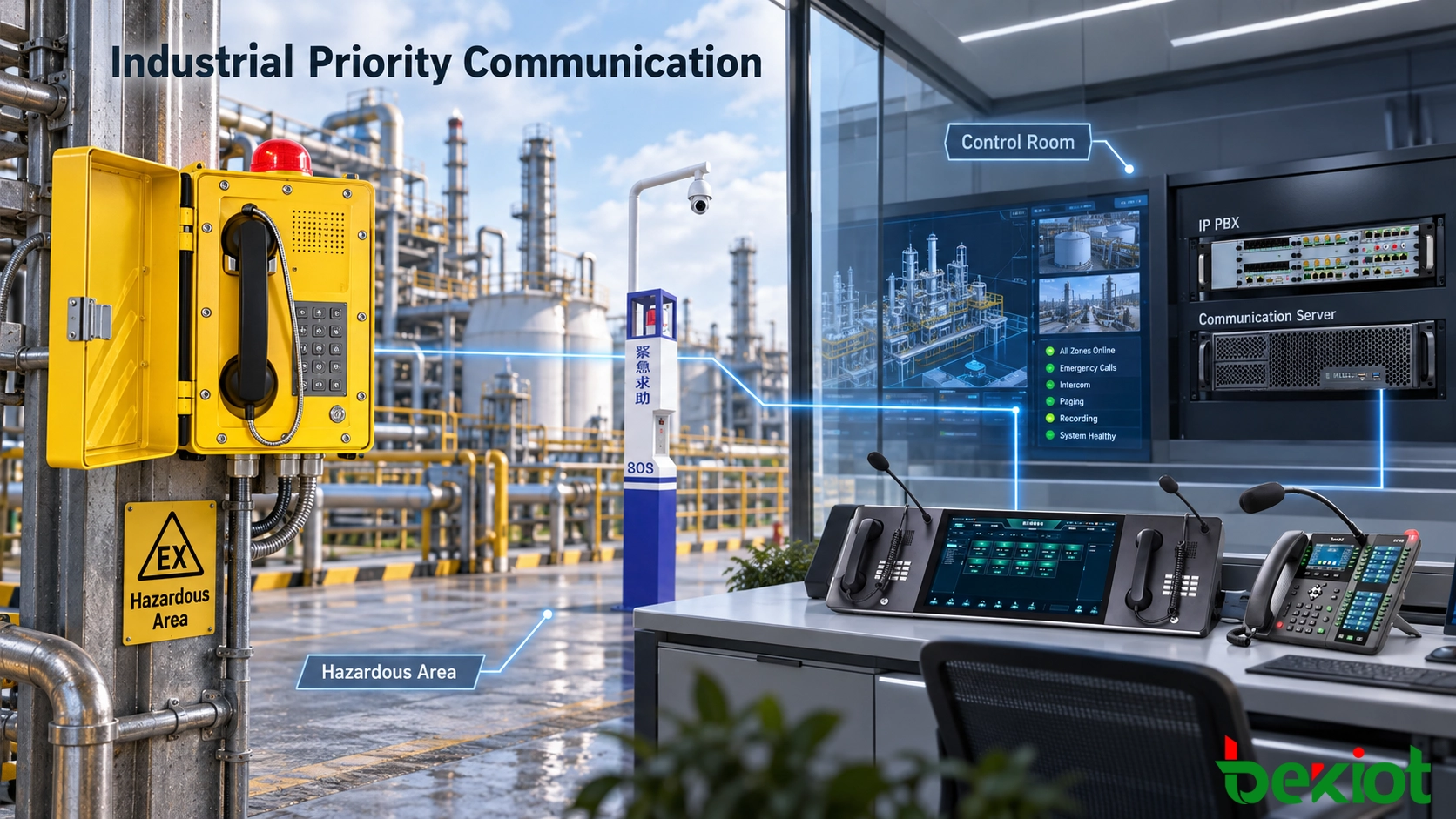
Oil and gas facilities, chemical plants, mines, energy sites and transport locations may require different environmental protection and operator workflows. An emergency route from a remote production area and a public passenger help point may share SIP signaling while requiring different location records and response groups.
For a Becke Telcom terminal or platform proposal, request evidence for the exact model, firmware, interface and required priority behavior. Hazardous-area suitability requires the appropriate certificate and installation scope; it is independent of a SIP priority setting. Do not infer either capability from the enclosure's appearance.
Recording and Event Analysis
Where required, record the authenticated caller, assigned category, selected route, queue or admission outcome, affected session if preemption occurs, operator action and final result. Audio recording is a separate supported function with its own permissions and retention policy. A call-detail entry cannot establish that useful two-way communication occurred.
Testing Priority Calls Before Handover
Agree expected outcomes before testing. Measure performance under recorded conditions instead of promising a universal response time. At minimum, exercise these cases:
An authorized emergency call with available operators and resources.
A routine call already occupying the specific resource the urgent call needs.
Two simultaneous emergency calls and an existing protected emergency session.
An ordinary account requesting an unauthorized elevated category.
A full queue or exhausted media/trunk capacity, with the configured final action.
An unanswered primary group, unavailable backup destination and recovery after the fault.
Priority classification across each platform or gateway boundary under representative network load.
For each case, compare the operator display with signaling, media and resource records. Verify what happened to displaced or waiting callers as well as to the urgent call. For establishment, answer, audio and termination checks, use the separate SIP emergency intercom call-flow procedure.
FAQs
Can priority calls work if an intercom has no priority menu?
Yes, if the call platform can apply an authorized policy using the endpoint account or another supported classification. That can provide selected routing or queue behavior without a special endpoint header. The required admission or preemption behavior still needs platform support.
Does automatically answering a call give it higher priority?
No. Automatic answer determines how a destination accepts a call. It does not by itself decide queue order, allocate a trunk or release another session. Its use also needs an operating policy appropriate to the location.
Can a queue guarantee an emergency call will be answered?
No. A queue organizes waiting requests but depends on available capacity and responders. Define its waiting limit, overflow action and visible indication when no response path remains.
Should an interrupted routine call resume automatically?
Specify that explicitly. A held call might be resumable, while a terminated session may require a new call. Check what the platform supports and how both parties learn the outcome; do not assume all forms of override preserve the original conversation.