

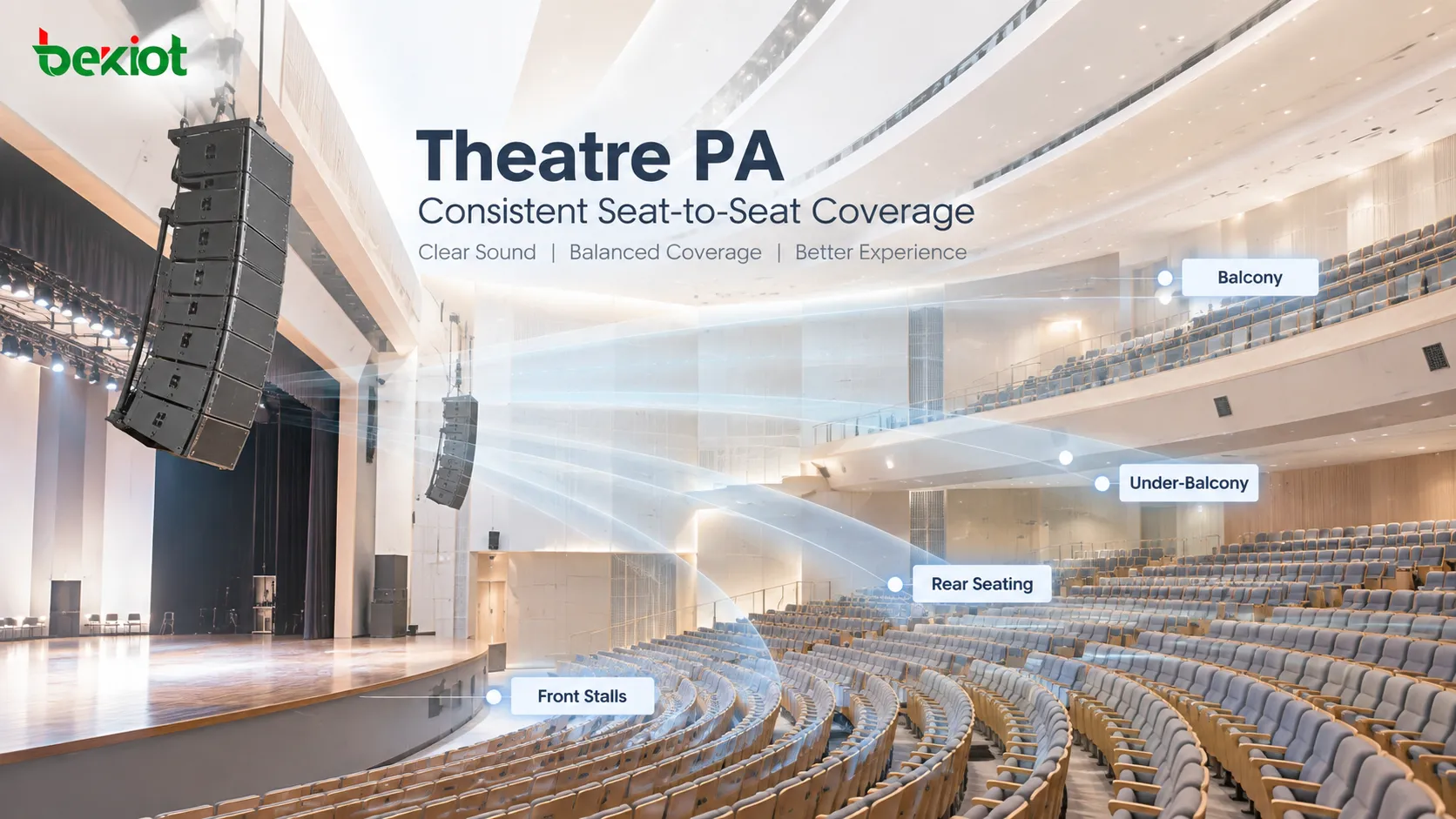
A theatre PA can produce high sound pressure levels (SPL) while delivering very different listening experiences across its seats. The front rows may be uncomfortable, dialogue may sound clear at the front-of-house (FOH) mixing position, and listeners under a balcony may still miss important speech detail. More amplifier power does not automatically resolve these differences.
The design objective is to combine sufficient output and dynamic headroom with controlled coverage across the stalls, balconies, rear seats and obstructed areas. Main loudspeakers, subwoofers where required, front fills and local delay loudspeakers have complementary tasks. Their selection, placement and alignment matter more than a single maximum-SPL figure.
A maximum-output specification is therefore only one part of a theatre PA brief. High output remains necessary where the programme requires it; a successful system also delivers useful sound consistently throughout the audience area. The broader public address system overview explains the underlying audio chain and zoning functions.
Why Output and Headroom Still Matter
Sound reinforcement helps speech and music reach listeners at adequate levels. In a large auditorium, sufficient amplifier capacity, loudspeaker sensitivity and acoustic output are essential: good aiming cannot make an undersized system reproduce demanding musical peaks without overload.
Maximum SPL describes output capability under stated test conditions; it does not describe the level or tonal balance at every seat. Comparing systems therefore requires attention to the measurement method, frequency range, distance and distortion or limiting conditions, rather than treating every published maximum as directly comparable.
Headroom is the margin between normal operating level and the system's usable limit. It allows transient peaks to pass without unwanted clipping or excessive limiting. That margin should support the production's dynamics, while operating levels remain appropriate for the audience and applicable sound-exposure requirements.
Why Increasing the Main Level Cannot Solve Every Coverage Problem
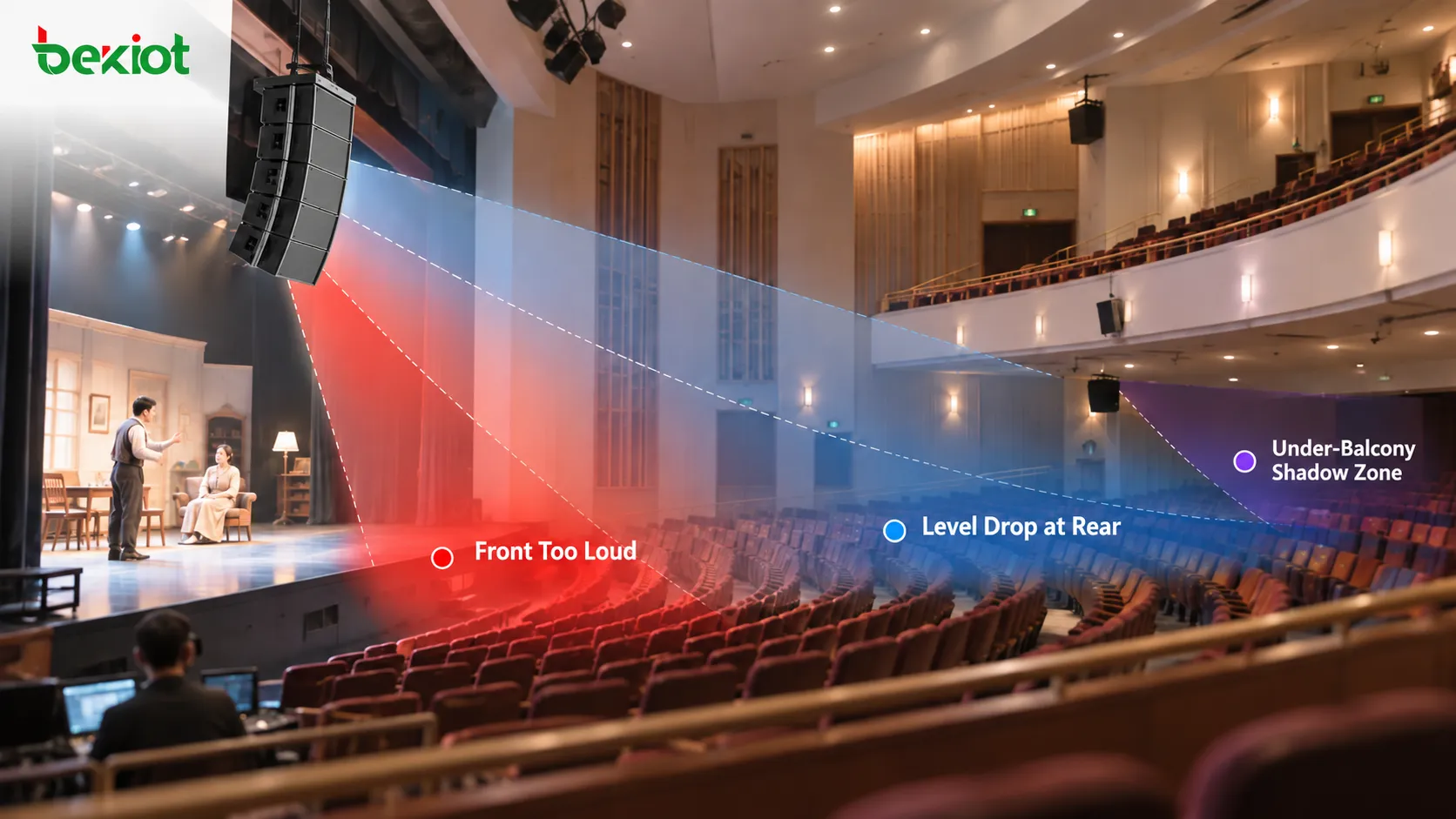
A theatre is not a flat listening plane. Front rows, rear stalls, upper galleries, boxes and seats beneath balconies have different distances and sightlines to the main loudspeakers. Raising the main level changes all areas reached by that system, including seats that were already adequately covered.
The first problem is excessive variation between seating areas. Trying to reach distant listeners by increasing the main output can make nearby seats unnecessarily loud. A system with enough overall capacity can still distribute that capacity poorly.
The second problem is acoustic shadowing. Balcony fronts, beams and other obstructions can reduce direct sound, particularly at higher frequencies. Raising the source level does not remove the obstruction or restore the same spectral balance everywhere; locally placed fills may provide a more useful direct path.
The third problem is room interaction. More main-system output raises both direct and reflected sound where those paths exist; it does not by itself improve their balance. Late reflections and excessive reverberation can obscure speech. However, reflections are not universally harmful: suitably early reflections can support intelligibility, as research by the National Research Council of Canada demonstrates.
What Consistent Seat-to-Seat Coverage Means
Consistency does not mean identical readings at every seat. Distance, room surfaces, seating and balcony geometry create unavoidable differences. The objective is to set practical project targets and keep variation controlled across all usable listening areas.
Level consistency concerns differences in sound level between seats. Frequency-response consistency concerns tonal balance, so a mix does not sound excessively bright at the front and dull at the rear. Speech-intelligibility consistency concerns whether dialogue remains understandable throughout the seating area. These are related objectives, but one cannot substitute for the others.
Timing and localisation also matter. A local fill should integrate with the main system without drawing distracting attention away from the stage. The best-covered and worst-covered positions, including the boundaries between zones, are more informative than one favourable result at FOH.
How Main Loudspeakers, Front Fills and Delays Share the Work
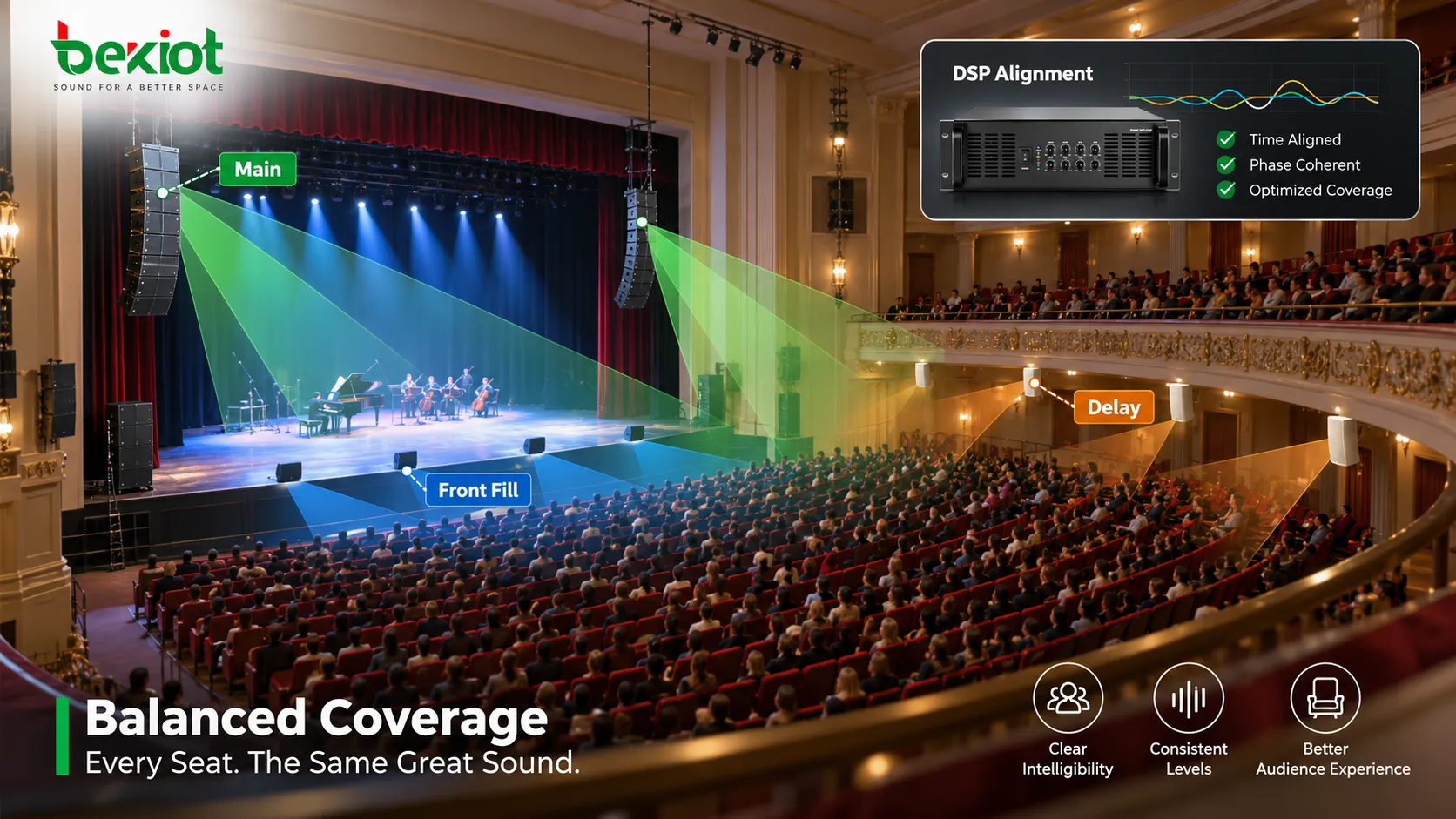
The main system covers the principal audience areas. Its position and directivity should direct useful energy toward listeners and limit unnecessary excitation of ceilings and other surfaces. A line array can provide useful vertical control, but it is not automatically the right choice for every theatre. Suitable point-source systems may also meet the brief.
Seats near the stage can fall outside the main system's effective coverage. Front fills support these rows with local direct sound. Their level, aiming and frequency range should complement the main system rather than make the stage edge a separate, dominant sound source.
Under-balcony or distant areas may need delay fills where the main system lacks a clear or adequate direct path. These loudspeakers should cover their assigned area with controlled spill. Delay and level settings help their output blend with sound arriving from the main system.
The required delay depends on acoustic path differences and the latency of the signal paths. It is established at representative listening positions, then checked through the overlap region. There is no single delay setting that guarantees correct alignment for every seat or every room.
Subwoofers, where needed for the programme, require separate attention. Low-frequency distribution depends on placement, interaction between sources and room behaviour; an even mid- and high-frequency coverage plot does not prove that bass is equally consistent.
A useful sequence is define audience zones → assign main and fill coverage → coordinate timing, level and tonal balance → verify the transitions. Distributed loudspeakers help only when their contributions are designed and commissioned together.
Why Coverage Design Starts Before Installation
Loudspeaker position, suspension height, array length, aiming and, for arrays, inter-element angles strongly influence coverage. These decisions can be expensive or difficult to change after installation, especially where rigging, architecture or sightlines constrain access.
Predictive modelling lets designers represent the stalls, balconies, stage and relevant room surfaces before selecting loudspeaker locations. It can reveal whether energy misses an audience plane, reaches a ceiling, or leaves a balcony transition inadequately covered. It also helps compare fill locations and coverage boundaries before hardware is fixed.
The model's scope must be clear. A direct-sound prediction is useful for aiming and level distribution, but does not automatically include reverberation, diffraction around obstructions, scenery or occupied-room effects. Results depend on geometry, loudspeaker data and the acoustic assumptions used.
Modelling therefore reduces avoidable design risk without replacing the engineer or on-site verification. It should guide a system that is physically installable, maintainable and appropriate to the production requirements, rather than simply produce an attractive coverage image.
Verify Performance Across the Audience Area
The installed theatre can differ from its model because of wall finishes, seating absorption, scenery, audience occupancy and installation tolerances. Commissioning must establish what the actual system delivers under recorded conditions.
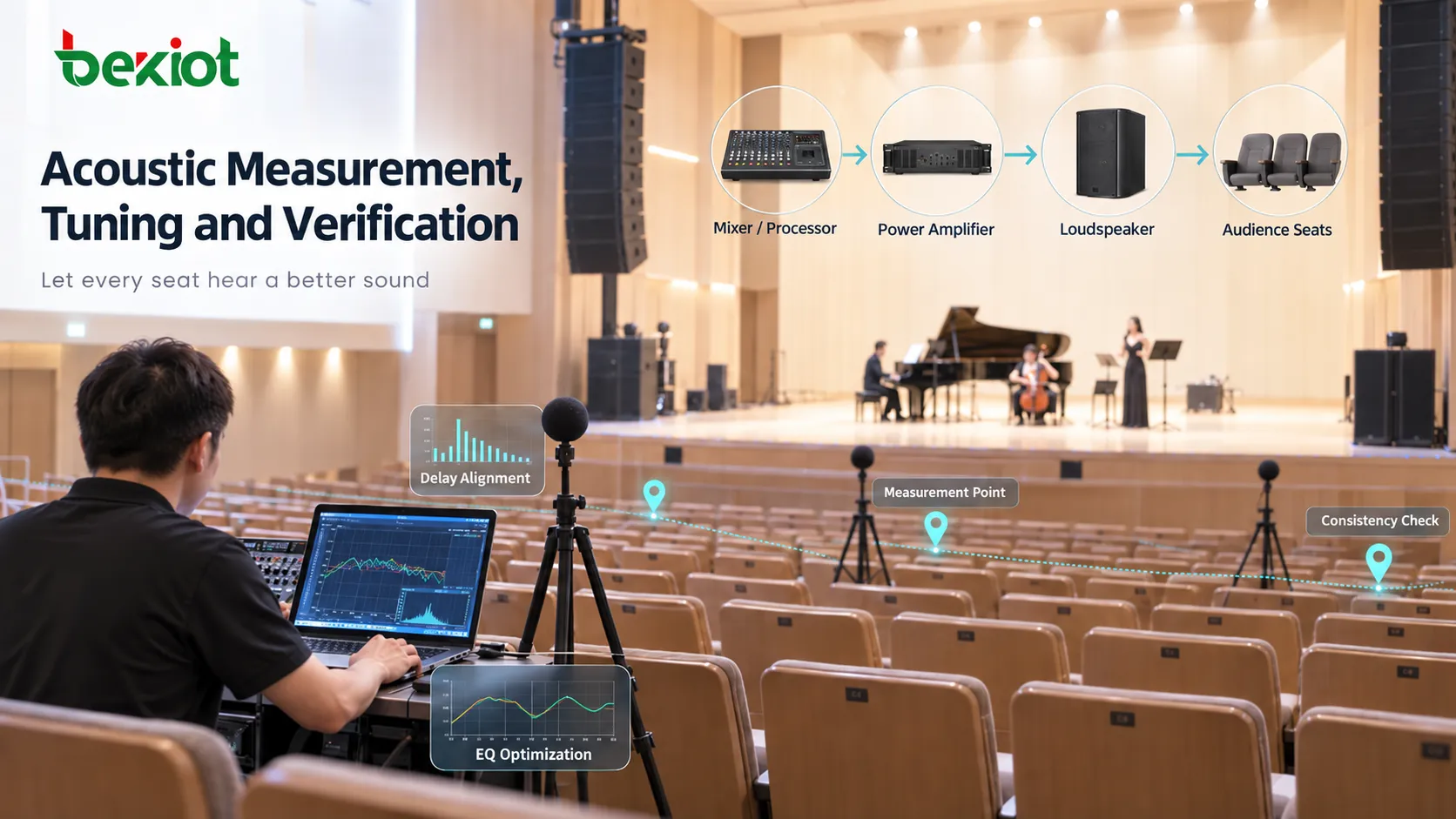
Measure representative positions in the front, middle and rear stalls, each balcony level, under-balcony areas and the overlap between main and fill systems. Include difficult edge seats. Record the microphone locations, system configuration, test level, background noise and room occupancy so later checks can be meaningfully compared.
Evaluate level distribution, frequency response, arrival times and speech intelligibility, then listen to representative speech and music. Check main and fill systems separately and together. Incorrect timing or level in an overlap can produce frequency-dependent interference, image shifts or a noticeable second arrival even when each loudspeaker sounds acceptable alone.
Where STI testing is appropriate, IEC 60268-16:2020, corrected version 2025-07, defines the STI model and measurement and prediction methods. Its published scope explicitly says it does not provide STI criteria for transmission-channel certification. A project must therefore specify its applicable acceptance criteria; a single STI result is neither a complete assessment of musical quality nor proof of voice-alarm compliance.
Equalisation can refine tonal balance, but it cannot remove a structural obstruction or solve every spatial cancellation. Correct placement and coverage first, then use DSP to refine integration. Retain commissioning records and revisit affected areas when seating, scenery, loudspeaker positions or processing change.
Evaluate the Sound Reaching the Seats
Better coverage gives the FOH engineer a more dependable basis for balancing dialogue and music. If tonal balance changes sharply across the room, equalisation that improves one area can worsen another. Controlling those differences makes mix decisions translate more predictably.
The practical design process is to define the audience area and programme, establish output and coverage targets, select and aim the main and fill systems, model their contributions, align the installation and measure the result. Adequate headroom and controlled operating levels belong in that same process.
The choice is not between SPL and coverage. Both must serve a stable, intelligible and as-consistent-as-practical audience experience. A useful theatre PA brief describes the required result across the usable seating area, rather than relying on a loudspeaker's maximum-output specification alone.
FAQs
Must every seat have exactly the same SPL?
No. Identical readings are unrealistic in a real theatre. Agree practical tolerances and assess level, tonal balance and intelligibility across representative positions, including difficult seats and zone boundaries.
Does consistent coverage eliminate the need for high output?
No. The system still needs sufficient usable output and headroom for the programme. Better coverage helps distribute that capability appropriately; it does not make an undersized system adequate.
Why can sound remain unclear beneath a balcony?
The balcony can interrupt the main system's direct path, while reflections and background noise still reach the listener. Raising the mains may increase levels elsewhere without correcting that local balance. A properly aimed and aligned local fill can help.
Does a line array guarantee uniform theatre sound?
No. Performance depends on the room, array size and position, aiming, fill design and commissioning. A suitable point-source system can also work well. Loudspeaker format alone does not establish coverage quality.
Can prediction replace on-site measurement?
No. Prediction helps compare design options and identify likely gaps. Measurement and listening confirm how the installed system behaves with its actual geometry, processing, noise and room conditions.
References
ITU-T HSTP-SLD-Venue (04/2024), Guidelines for safe listening at venues and events: sound distribution, loudspeaker placement and delay fills.
Bradley, Sato and Picard (2003), On the importance of early reflections for speech in rooms: research on useful early reflections and intelligibility.
IEC 60268-16:2020, corrected version 2025-07: published scope of STI measurement and prediction methods.