

A maintenance visit, an unfamiliar gateway or a stolen extension account can become a route into business voice services. Ordinary broadband and voice equipment can be misused when installation and access are not controlled. The practical defense begins with knowing which devices are authorized and how they are allowed to communicate.
Caller ID is a presented identity, not sufficient proof that a caller or device is trustworthy. Enterprise protection must cover physical access, endpoints, accounts, SIP trunks, routing and incident response. VoIP is not inherently a fraud system, and a small gateway is not evidence of wrongdoing by itself; authorization and observed behavior matter.
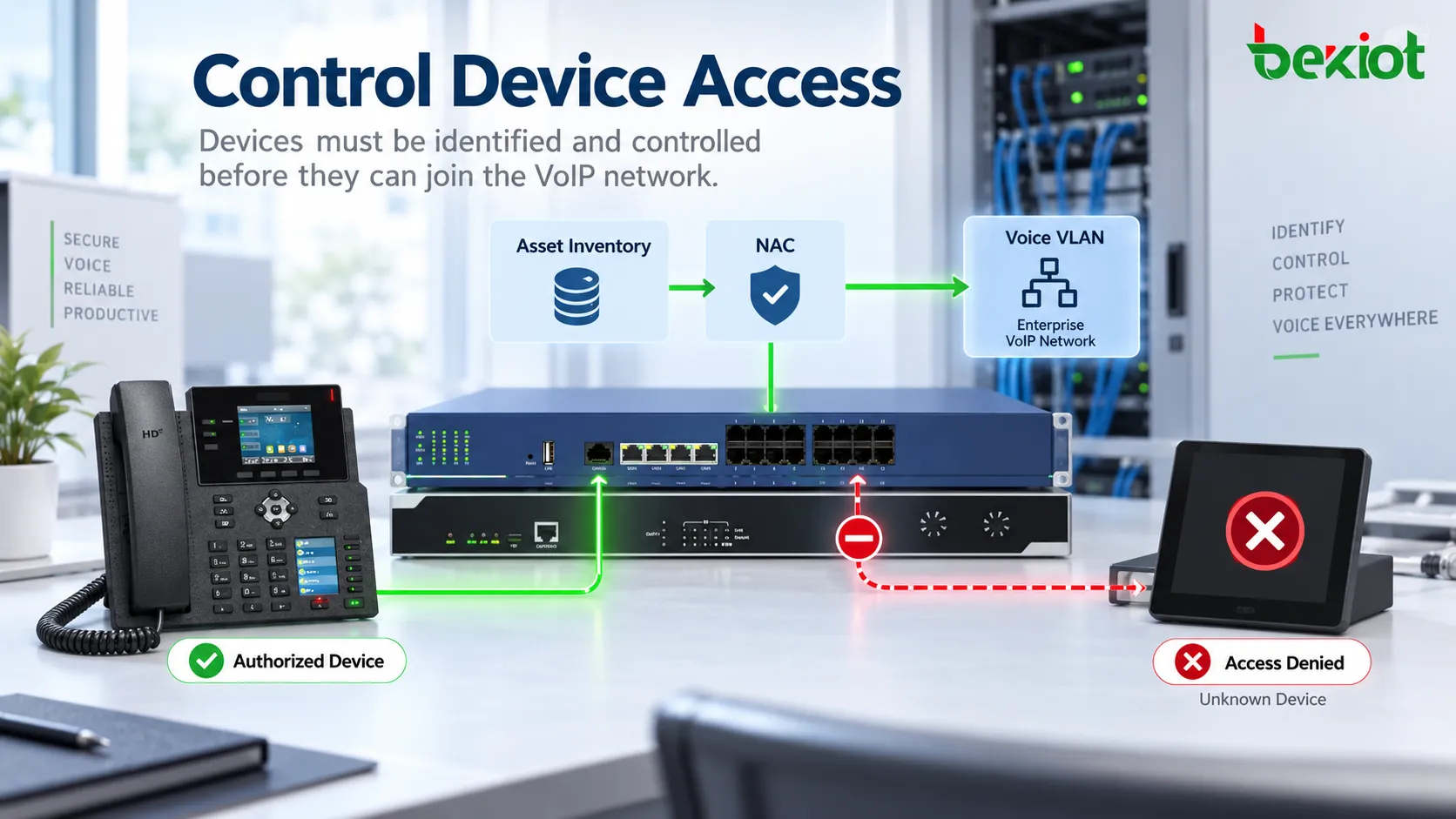
Know every device on the voice network
Maintain an inventory of IP phones, ATAs, gateways, SBCs, IP PBXs and conferencing devices. Record model, software version, network identifiers, installation location, owner and business purpose. Reconcile this inventory with switch and platform records, and require approval for additions or temporary test equipment.
Separate voice and management traffic where appropriate, restrict communication between segments, and use supported 802.1X or network admission controls. A Voice VLAN alone is not authentication. MAC-based controls are weaker than cryptographic device authentication because addresses can be copied; use them as supporting controls where stronger methods are unavailable.
Lock equipment rooms, supervise visitors and disable unused ports where operationally appropriate. A legitimate work order should explain who connected each device and why. Check branch offices and exposed network sockets as well as the main server room, and remove temporary equipment when maintenance ends.
Manage SIP accounts through their full lifecycle
Create voice accounts with an owner, approved role and defined calling rights. Disable accounts promptly when staff leave or contractors finish, and change permissions when roles change. Separate ordinary SIP extensions from web administration accounts; a telephone number and a long-lived shared password are insufficient identity management.
Use unique credentials, secure provisioning and supported certificate or device controls. Multi-factor authentication is valuable for administration and supported application sign-in, but a conventional SIP endpoint using digest authentication may not support an interactive MFA prompt. Protect those endpoints with compatible network access and credential controls rather than claiming MFA covers every registration.
Restrict administration to trusted access paths, such as a controlled VPN or jump host, and log changes. Monitor unusual registrations and investigate unfamiliar devices or networks. Travel, carrier address changes and legitimate redundant clients can explain some anomalies, so location changes alone should not automatically prove compromise.
Control the external SIP boundary
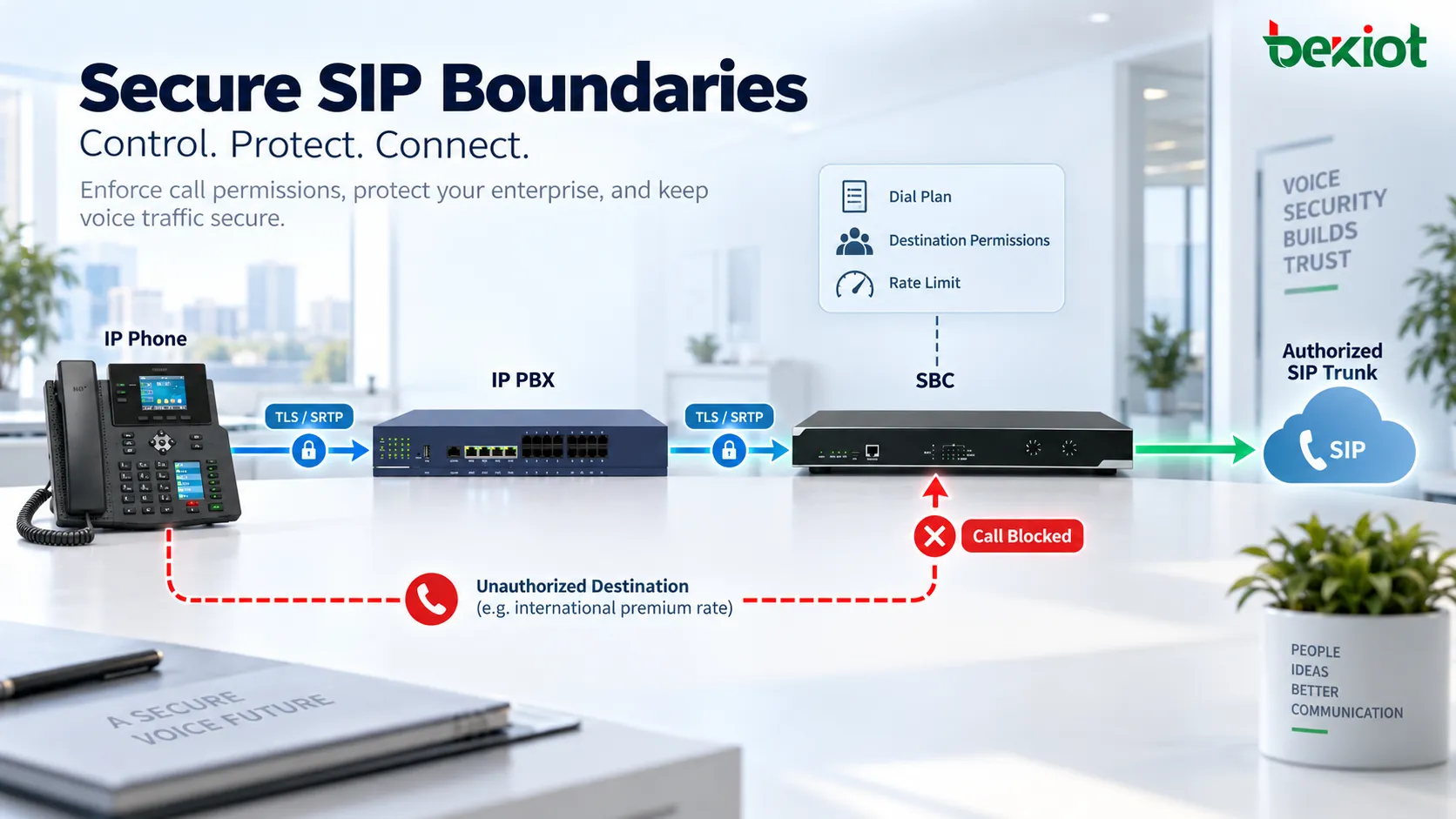
An SBC can enforce session policy between the enterprise and authorized carriers, cloud services or remote users. Depending on its capabilities, it can validate signaling, limit session rates and concurrency, apply access policies and conceal parts of the internal topology. It needs correct configuration, maintenance and appropriate capacity.
Combine this boundary with firewall rules, source restrictions where feasible, rate limits and denial-of-service planning. Permit only required signaling and media paths. Public management ports and broad troubleshooting exceptions should not remain open after commissioning. Carrier address ranges may change, so approved rules also need maintenance.
Document the normal route from internal voice service through the controlled perimeter to an authorized carrier or platform. An SBC is not a universal firewall, fraud detector or identity guarantee. Test the actual enforcement, including rejected sessions, permitted remote users and continued service under the agreed load.
Limit what a valid account can call
Successful authentication should not grant unrestricted international, premium-rate or SIP URI calling. Set a class of service by role and restrict destination ranges to business needs. An unattended help point may only need approved control-room destinations; an international sales team may require a broader but still explicit policy.
Apply suitable concurrency, duration, usage or spending limits where supported by the platform and carrier. Combine alerts with an agreed response. Thresholds need a business baseline: a busy contact center or on-call team may legitimately differ from a desk extension used only during office hours.
Review dial plans, forwarding, voicemail access, transfer permissions and unused trunks. A restricted extension can still expose a costly route if forwarding or transfer rules bypass its policy. Preserve required emergency access and define a controlled exception process; fraud containment must not indiscriminately disable critical communication.
Protect signaling and media separately
TLS can protect SIP signaling on the connections where it is enabled and validated. SRTP can protect media confidentiality and integrity when configured with suitable cryptography and key management. Neither is established simply by selecting a port or displaying a secure-call icon.
Check certificate trust, server identity, expiration, private-key protection and compatible settings on each segment. Moving from port 5060 to 5061 alone does not establish security. SRTP requires a supported method of establishing keys; SRTP itself does not define a complete key-management system.
An SBC, media proxy or carrier may terminate encryption and start another protected segment. Confirm which parties can access signaling or audio and where the path becomes unencrypted, particularly at a PSTN boundary. Encryption does not replace account authorization or call policy: stolen valid credentials can still originate an encrypted fraudulent call.
Monitor behavior as well as protocol validity
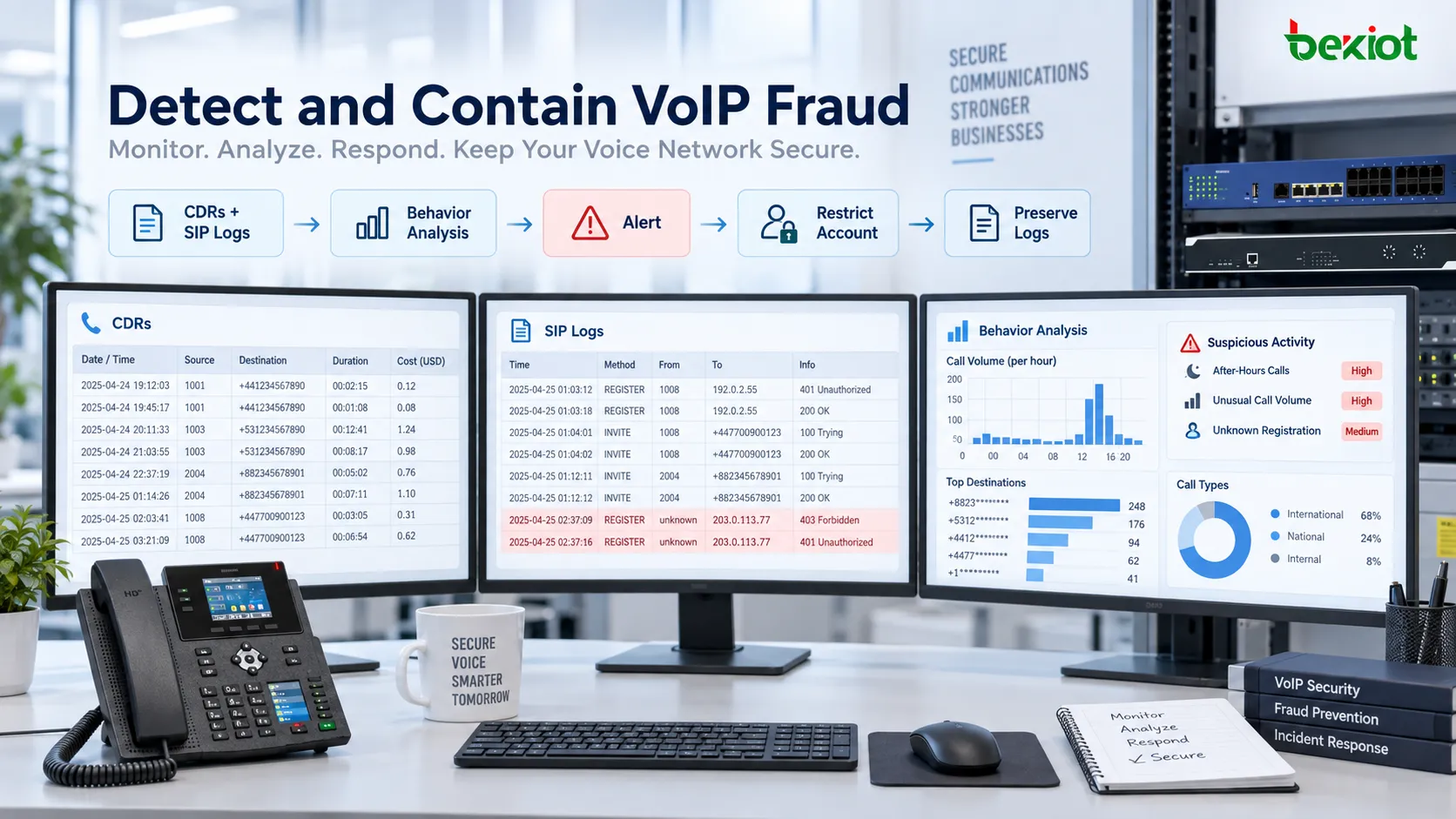
Collect useful call detail records (CDRs), registration and authentication events, trunk activity and administrator changes. Compare destinations, duration, concurrency, failure rates, time of day and endpoint sources against expected business patterns. An allowed SIP INVITE can still start a call that the business never intended to authorize.
Examples worth investigating include overnight international calls from a normally daytime account, a dormant trunk carrying sudden traffic, repeated registration changes or a sharp increase in short calls. Each signal can have a legitimate explanation. Correlate evidence and set review priorities rather than treating every deviation as confirmed fraud.
Rules and statistical or AI-assisted analysis can help identify patterns, but require usable data, tuning and human ownership. Define who receives an alert, how quickly it is reviewed and when restrictions apply. Measure false positives as well as missed events; no model or protocol check guarantees fraud prevention.
Prepare containment and evidence before an incident
Keep synchronized time across the IP PBX, SBC, firewall and monitoring systems. Retain enough CDR, authentication, provisioning and routing-change information to correlate parties, timestamps, duration, trunk and result. Protect logs from unauthorized access or alteration and set retention according to operational and applicable privacy requirements.
A response plan should identify the duty owner, carrier contact and authority to restrict an account or route. Preserve relevant evidence while containing the problem. Where possible, limit the affected destination or account and maintain essential calling. Credential reset alone is inadequate if an attacker still controls a device, provisioning source or administrator account.
Investigate the scope, remove unauthorized equipment or configuration, correct the entry point and verify service before restoration. Record decisions and review the controls after recovery. Pre-approved responses can shorten containment, but automatic blocking must be tested against legitimate travel, peak demand and emergency workflows.
Verify maintenance visits and third-party access
Check unexpected installation or upgrade requests through a known internal contact or an independently obtained official service channel. Uniforms, badges and a telephone number supplied by the visitor are insufficient verification. Match the visit to a work order and record the equipment introduced or removed.
Give contractors named, time-limited access with only the necessary scope. Supervise physical work, log remote administration and revoke access when complete. Train staff to report unfamiliar devices and suspicious requests promptly; technical access controls work best when routine maintenance procedures support them.
Turn the controls into an operating system
The useful chain is identifiable devices, controlled access, managed accounts, limited routes, protected traffic, monitored behavior and practiced response. Patch supported firmware and software, back up approved configurations and test restoration. Assign an owner to each control so it remains effective after the initial installation.
For a Becke Telcom solution, identify which controls belong to the endpoint, IP PBX, gateway, SBC, carrier or an integrated security platform. Request documented support and configuration evidence rather than assuming every device provides spending limits, MFA, analytics or automated isolation. Cloud hosting also leaves responsibilities for the customer's accounts, devices and permissions.
Validate the design with approved tests: reject an unknown endpoint, deny a prohibited destination, verify encryption on agreed segments, generate a safe test alert and rehearse account containment and recovery. Use authorized test accounts and destinations. Record what was demonstrated, what remains manual and who acts outside business hours.
FAQs
Does a cloud PBX provider manage all VoIP security?
No. Responsibilities vary by service agreement. The customer typically still manages users, endpoints and calling permissions, while the provider manages specified infrastructure and service controls. Document the division, incident contacts and available evidence.
How often should a voice system be reviewed?
Use a risk-based schedule and review after major upgrades, new trunks, changed remote access, carrier migration or an incident. Continuous alerts do not replace periodic checks of accounts, software support and accumulated routing exceptions.
How should a maintenance provider receive remote access?
Use a named account through an approved VPN or controlled jump host, limited by time and task. Keep a record of logins and changes, and revoke access after the work. Avoid a permanent shared administrator password.
Must every voice packet be stored long term?
Usually not. Full captures can include private signaling or audio and create large storage and access burdens. Retain necessary logs and CDRs under an agreed policy, using scoped, authorized packet captures for specific troubleshooting or investigations.
Technical references
IETF RFC 3261: SIP authentication and transport-security boundaries.
IETF RFC 3711: SRTP media protection and external key-management requirements.